
You know the whole star-crossed lover deal. Boy and girl from rival families fall in love with each other and eventually end up being torn apart, the eventual separation their inevitable moira. When you transpose this premise to a romantic comedy, of course, the star-crossed lovers are not so tragically fated after all; they always magically end up together. This premise is not at all uncommon, and Han Yew Kwang's latest film Perfect Rivals borrows that concept for the basis of its narrative conflicts.
Touted as his first foray into commercial cinema(though 18 Grams Of Love and From Hainan Meets Teochew were also pretty commercial films in my opinion, perhaps only sufferring from limited screening), Perfect Rivals revolves around two rivalling families in the bak kwa business, one headed by Zeng Mei Mei (Irene Ang) and the other by Chen Hao (Ha Yu). The two have some history to them, being lovers in their youth as well as sharing the same mentor. Mei Mei's business is burgeoning, however, and her life happens to look glitzy at first glance: she has a modern looking shop, a beautiful home and two very beautiful daughters. Chen Hao is portrayed as a man down on his luck. Bitter and angry about his business' ailing sales, his only (self) consolation comes from the pride derived from his better tasting bak kwa. He has two children whom he sees as a disgrace to him: an autistic child who constantly imagines himself as superman (Stanlyn Hsu) and a drunkard good-for-nothing son (Josh Lai).
With a bak kwa tournament looming ahead, Mei Mei, worried that Chen Hao may claim the crown of King of Bak Kwa with his secret recipe, decides to send her slightly boyish looking young daughter Yuan Yuan (Mindee Ong) to spy on him, under the guise of working for him. Of course, that is where things start to get messy, with both Mei Mei's daughters very fortuitously - and somewhat bizarrely - falling in love with Chen Hao's two sons. The ending will come as a surprise to none.
Han's quirky visual flair shines through in one of the early scenes, where the members of the two rival families were introduced in brilliant fashion, as the two families were trying to outdo one another with their different business tactics. A favourite filmic device of his is going balls out wacky with the surreal scenes, and clear examples would be the aforementioned 18 Grams of Love and From Hainan Meets Teochew. In this film, the flashback scenes of Mei Mei and Chen Hao provide the outlet for Han to put his stamp onto the otherwise insipid and lacklustre A.I. Pictures outing.
The film struggles to deliver the laughs. One may criticize many local comedies (e.g. those directed by Jack Neo) for never evolving, often sticking to the same slapstick schtick and familiar gags to up the humour quotient, but at least most of the time those films have an anarchic energy throughout their course that gives a constant sense of fun and adventure. Perfect Rivals suffers from very inconsistent pacing; some scenes are over-the-top fun, like the massage scene with both Mei Mei and Chen Hao trying to spite each other, but many others feel flat. Fortunately, many otherwise lacklustre scenes are buoyed by the spirited performance of Mindee Ong, who plays Yuan Yuan with much verve, and her scenes are some of the funniest in the film. Ha Yu, being the veteran that he is, turns up a solid performance too, but the same can't be said of the two playing his children. Stanlyn Hsu and Josh Lai turned in absolutely dull, lifeless, and at parts even annoying performances that are occasionally cringe worthy. The usually ebullient Irene Ang is muted down somewhat for this role, and her performance appears contrived at times, perhaps due to her lack of comfort with the mother tongue.
More worrying though, is the revelation that both Mei Mei's daughters may have been fathered by Chen Hao. This development may at first seem to suggest both of them has a deeper bond than we had expected, but it also throws an otherwise innocent family film into incestuous territory. That the children get coupled along the way so coincidentally is already bizarre in itself; but when the curveball is dropped along the way that the children of Mei Mei and Chen Hao may in fact be siblings, there is a disturbing incestuous tone underscoring the remainder of the film. The film does not try to sort out details of the relationship between the couples; it is solely focused on the relationship between Mei Mei and Chen hao, and of course the film ends on a good note when both of them get back together. This plot development (Yuan Yuan realizing she may be Chen Hao's daughter) is probably meant as a mechanism for Mei Mei's children to understand her past history with Chen Hao and also to push her to reconciliation with him, but it reduces the supporting characters to mere peripherals as it essentially trivializes their relationships, since their blood relations will no longer render them romantic lovers.
Entertained by the film, I sure was, but to say that Perfect Rivals is less than perfect would be an understatement.
Showing posts with label Writer: Raymond Tan. Show all posts
Showing posts with label Writer: Raymond Tan. Show all posts
Wednesday, March 23, 2011

Saturday, March 5, 2011
Forever by Wee Li Lin - A Review
 While I tire of insipid romantic comedies with tiresome and formulaic plot lines, I think wading into the shark infested of waters of mental disorders in a film can be potentially disastrous. Wee Li Lin's sophomore feature effort, Forever, bravely ventures onto this more sombre ground. Though marketed as a romantic comedy, it eschews the cliche of the "love conquers all" sentiment so commonly found in the genre, instead dialling up the dark comedy and satirical quotient. The film is part mass entertainment, part subversive genre exercise, and the latter lends the film some appeal and depth, though its premise seems inherently problematic, and its over-ambition stunting its effectiveness as social commentary. More on that later.
 The film pivots around Joey (Joanna Dong), video consultant at the Wedding Education Department (WED), a government organization modelled to parody the Social Development Unit (one of the film's smarter tongue-in-cheek commentaries). She has secretly fallen in love with Gin Lee (Mo Tzu Yi), a music teacher from Taiwan. The two played bride and groom in a promo video that Joey recently made for WED, and it is during this little misadventure that Joey developed feelings for Gin. She mistakenly believes, however, that he reciprocates her feelings, but only later finds out he has a fiancée, Cecilia (Sarah Ng).
Joey is soon tasked to make another wedding video, and she tries to get Gin to act in it. While he tries to work his way out of it, he eventually strikes up a deal with Joey: he would act in the video if she agrees to leave him and Cecilia alone.
Li Lin's efforts in veering away from the oft-trodden path is commendable, and from the get go she tones down the fluff, opting for a darker tone that underscores the entire film. In the early segments of the film, we see not just its romantic premise but also Li Lin's well crafted set up for satire and commentary. She pokes fun at the WED employees - most of them are quite ironically weird and single - in a rather blatant parodic jibe on the SDU. It is also a subtle statement on the hypocrisy that lies beneath government organizations and bureaucracy. The name of the wedding department itself is an attempt to poke fun on Singapore's obsession with acronyms.
The commentary works on a few levels. The genesis of Joey's psychosis is deliberately ambiguous, and the writers, in a narrative sleight of hand, want you to form your own ideas as to its origins. Could it have been the societal pressure that drove her insane? Her mom (or was that her landlady? I was scribbling notes so I didn't quite catch the relationship) constantly interrogate Joey on her love life, so it may have been parental pressure to get hitched that drove her all batty. Or could it have been pressure from her own employers to get married that drove her to such an obsessively lovesick state? If that is the case, the film sends out a cautionary message against the dangers of governmental forces trying to intervene in the love lives of everyday folk.
The bright, zestfully cheerful colours, especially during Joey's wonderfully shot fantastical scenes, juxtaposed against the bleak subject matter at hand - psychosis and delusion - also serves as commentary on life in modern suburban Singapore - that beneath the glossy exterior lies an ugly monster waiting to rear its ugly head. It speaks of a faux utopia concealing a dark side that is repressed.
 I thought it was in the area of comedy that the film suffers. The film tries hard to balance humour and commentary, never marrying both successfully, and midway through it seems to lose its sense of identity, not quite sure what it is setting out to do. While early scenes featuring the WED employees elicited some laugh, the film was largely humourless for most of its course, unless of course you find Joey's delusions and fantasies funny. (I actually found her annoying but still thought it cruel to laugh at her). It is here that I find the film's premise problematic: its romantic comedy styling does not back up its social commentary well. In fact, using the lovelorn Joey's delusions and craziness to elicit laughs is counter-effective: it trivializes her illness, reducing it to a mere humour machine. Instead of further exploring this psychosis and the gradual degeneration of Joey's mental state, her malady becomes the one constant in the film that doesn't quite change, a tool mined over and over again to tickle the audience. Because her mental disorder is such a huge metaphor in the commentary, the film's neglect in exploring Joey's mental condition somewhat blunts the effectiveness of the film's social messages.
*ALERT: MAJOR SPOILER COMING UP*
The film's ending was by far its weakest point. While the later parts of the film seemed to waver in consistency, by the end it seemed to abandon all logic and devolve into an entire exercise in hysteria. In a really bizarre scene, local pseudo celebrity Ris Low as well as respected theatre lecturer Dr Seet appear in an asylum/mental hospital/psychiatric support group, referred in the film by their real life moniker. There is no good reason for their random appearance. One might think this would add a touch of zaniness to the film, but there is a fine line between campy fun and silliness, and this absolutely incoherent scene nearly plunges the film into self parody, almost as if it was as hysterical as Joey herself.
Fortunately, for the most of the early and middle segments, the film was smart and beautifully shot. Forever, as with Gone Shopping, highlights Li Lin's promise as a filmmaker with a knack for exploring social issues through the lenses of quirky, slightly off-kilter characters, and the film brings memories of a time when local comedies had the gravitas to provoke social discourse (as with I Not Stupid and Money No Enough). The film has a lot of potential, and if its premise was fine-tuned a little, could have been a lot better. The cast put up competent performances, with Joanna Dong quite nimbly balancing the psychotic side as well as the innocent and sweet sides of Joey. Her graceful, polished vocals is also featured a couple of times in the film when she sings a love song. If anything, her performance in it is reason enough to have a go at this movie.
 Catch Forever in Golden Village cinemas now!!! Click here for details.
Thursday, February 3, 2011
River Hongbao 2011 + Anthony Chen's 'The Reunion Dinner'
So SINdie's Jeremy Sing scored an invite to the largest annual celebration of Chinese New Year - River Hongbao. I went in his place since he couldn't make it (he was busy working on SINdie's poster exhibition!) and I was eager to see Anthony Chen's commissioned film 'The Reunion Dinner'.
I pondered for a long time on a better title for this post, for something that didn't scream 'THIS EVENT IS BORING AS BATSHIT', but any potentially witty working title eluded me. Probably because the event was really that boring - much of it was spent waiting. But this is coming from me, a somewhat young and cynical Gen X dude, so you might want to take my words with a pinch of salt.
Instead I'll touch on the positive points!
Well, the organizers have kindly done the younger audience members a favour by not having some getai singer belt out songs from thekaraoke hitlist of hell list of CNY songs. In place they had a Chinese Orchestra playing a couple of songs; their music being something you'll either enjoy or find torturous to sit through. I'm guessing for the 70% of the audience members who are elderly, they'll belong to the former group.
The highlight of the night was definitely Anthony Chen's 'The Reunion Dinner'. More on that in a while.

The Singapore Chinese Orchestra on stage playing some numbers before the arrival of MM Lee.

Kids here dressed up as rabbits, in shiny tutus and complete with bunny ears. I find that wildly inappropriate somehow (even if it is the year of the Rabbit), but oh well. Whatever floats the audience's boat.

The arrival of MM Lee. I couldn't get a good picture of him on stage, so I decided to take a photo of him on the screen.


The Singapore Chinese Orchestra playing the score to 'The Reunion Dinner' live.
First impressions of 'The Reunion Dinner': The film tracks the protaganist's life in his family through the motif of tradition - in this case, a family's reunion dinner. The film spans three different eras: the protaganist as a young boy, then a teenager, and finally a grown man (and a father). Beautifully reconstructed sets are a sight to behold. The slightly muted colours of the scenes in the 70's and 80's manage to simultaneously convey both the simplicity of its time, as well as the vibrancy of life then; juxtaposed against the piercingly sharp colours of the scenes in the final act, he makes clear the progress and development Singapore has went though in the past decades, and makes a strong statement on the sophistication of modern Singapore. He then uses this to drive home the message that Singapore's outward appearances might have changed and life might be radically different now, but the tradition of the CNY reunion dinner, as well as the heart of the ritual - the importance of family - will and must endure. As a festival commissioned piece, the film may be forgiven for painting an overly optimistic picture of family, one nearly devoid of conflict throughout its course. Still, Anthony Chen remains a master of exploring basic human sentiments often difficult to articulate through a minimalist script, much in the vein of previous works 'Ah Ma' and 'Hotel 66' (though The Reunion Dinner has comparatively more dialogue). In this film he succintly portrays the love of family without resorting to emotional histrionics. I think it is this minimalism that I'm starting to see define his works - his films may have an interesting premises and beautiful textures, but he strips his films bare by discarding the (overly) dramatic elements so often resorted to, and uses the most mundane and common everyday gestures to explore basic human impulses and subsequently bring about a modicum of catharsis. (Of course, I've only watched 3 of his shorts so far, so this is just my general impression.)

I pondered for a long time on a better title for this post, for something that didn't scream 'THIS EVENT IS BORING AS BATSHIT', but any potentially witty working title eluded me. Probably because the event was really that boring - much of it was spent waiting. But this is coming from me, a somewhat young and cynical Gen X dude, so you might want to take my words with a pinch of salt.
Instead I'll touch on the positive points!
Well, the organizers have kindly done the younger audience members a favour by not having some getai singer belt out songs from the
The highlight of the night was definitely Anthony Chen's 'The Reunion Dinner'. More on that in a while.

The Singapore Chinese Orchestra on stage playing some numbers before the arrival of MM Lee.

Kids here dressed up as rabbits, in shiny tutus and complete with bunny ears. I find that wildly inappropriate somehow (even if it is the year of the Rabbit), but oh well. Whatever floats the audience's boat.

The arrival of MM Lee. I couldn't get a good picture of him on stage, so I decided to take a photo of him on the screen.


The Singapore Chinese Orchestra playing the score to 'The Reunion Dinner' live.
First impressions of 'The Reunion Dinner': The film tracks the protaganist's life in his family through the motif of tradition - in this case, a family's reunion dinner. The film spans three different eras: the protaganist as a young boy, then a teenager, and finally a grown man (and a father). Beautifully reconstructed sets are a sight to behold. The slightly muted colours of the scenes in the 70's and 80's manage to simultaneously convey both the simplicity of its time, as well as the vibrancy of life then; juxtaposed against the piercingly sharp colours of the scenes in the final act, he makes clear the progress and development Singapore has went though in the past decades, and makes a strong statement on the sophistication of modern Singapore. He then uses this to drive home the message that Singapore's outward appearances might have changed and life might be radically different now, but the tradition of the CNY reunion dinner, as well as the heart of the ritual - the importance of family - will and must endure. As a festival commissioned piece, the film may be forgiven for painting an overly optimistic picture of family, one nearly devoid of conflict throughout its course. Still, Anthony Chen remains a master of exploring basic human sentiments often difficult to articulate through a minimalist script, much in the vein of previous works 'Ah Ma' and 'Hotel 66' (though The Reunion Dinner has comparatively more dialogue). In this film he succintly portrays the love of family without resorting to emotional histrionics. I think it is this minimalism that I'm starting to see define his works - his films may have an interesting premises and beautiful textures, but he strips his films bare by discarding the (overly) dramatic elements so often resorted to, and uses the most mundane and common everyday gestures to explore basic human impulses and subsequently bring about a modicum of catharsis. (Of course, I've only watched 3 of his shorts so far, so this is just my general impression.)

Saturday, January 29, 2011
HomeComing (笑着回家) Review: Home Is Where the Heart Is
 As the saying goes, "a house is not a home". Well, this begs the question: what exactly is home?
 There are some local films that attempt to examine this problematic concept of home, as well as its attendant notions of belonging and community. The more ambitious ones conflate home with the nation and attempt to explore one's identity with regards to the Singaporean soul - whatever the hell that may be.
Homecoming (笑着回家) is smart in that its premise cleverly helps to navigate itself out of the quagmire of impossible answers and heavy-handed philosophical musings. The onus here is on the journey; its conceit is that it thrives on the (reasonable) assumption that audiences carry a tacit knowledge that wherever the characters end up in the end, that is 'home' to them. It does not matter how different the homes of the different characters are, because the film makes it clear it is the ride that matters most. And it sure is one hell of a ride!
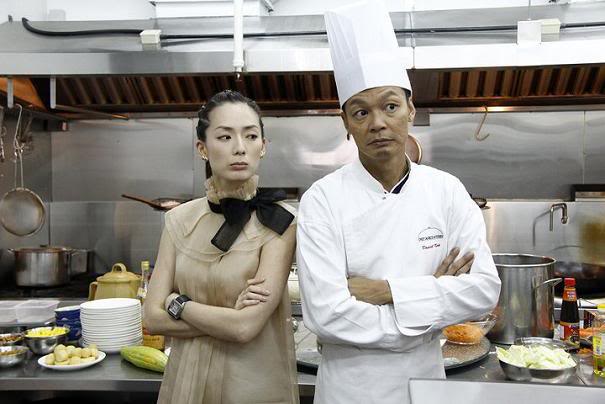 The film weaves together three stories with vastly varying tones. There is the insufferable chef Daniel Koh (Mark Lee) firing his entire staff on the day he is supposed to prepare a reunion dinner for the Minister of Culture, except for the capable, ebullient restaurant manager Fei Fei (Jacelyn Tay). As they say, when it rains it pours, so somehow amidst the chaos in his restaurant, he also finds the opportunity to further push away his already somewhat estranged daughter (Koe Yeet).
There is the pair of newlyweds, Boon (Huang Wenhong) and Jamie (Rebecca Lim), who just got back to their parents' place for reunion dinner, except that a small dilemma plagues them. They have a free flight to Bali on the night of the reunion dinner, and so have to leave early; they have no idea how to break this news to their parents. While somewhat lapsing into caricature, the couple - in particular the English-educated wife played by Rebecca Lim - does reflect Gen X's and Gen Y's growing disdain with tradition.

Then there is Karen Neo (Jack Neo) and her irritable son Ah Ming(Ah Niu) who embark on a roadtrip of sorts to get back to Kuala Lumpur for their family's reunion dinner. Of course, Jack Neo's cross dressing stint is one of the highlights of the film (and a fact not forgotten by the film's marketing team). He hamming it up here as a naggy aunty brings to mind his exuberant turn as the wildly hilarious Liang Po Po years back. The scenes in this third story contain the funniest moments in the film. The mother-son duo has a dynamic chemistry between them, but this is quickly weighed down by Koe Yeet's character bumping into them on the coach they are taking. Her character is an emotional trainwreck in the aftermath of her father's outburst towards her; her entrance into this scene is reminiscent of the wet blanket crashing a party he was not invited to. Her forced expressions are starkly foregrounded next to Jack Neo's and Ah Niu's naturalism as they effortlessly inahbit their characters, and her scenes on the bus with them feel extremely uneven in tone and energy. Having said that, the doe-eyed Koe does bring a certain vulnerability to her character.
Fortunately, despite all the emotional histrionics of an angsty teen, the mood is buoyed upon the arrival of a taxi driver, Zool (Afdlin Shauki), who helps rush Karen Neo and Ah Ming back to their home.
Directed by Lee Thean-Jean, who has written and directed episodes of TV's The Pupil, Homecoming (笑着回家)is quite the debut feature film. From the get go, Lee displays a keen eye for pacing and he shows a clear aptitude for drawing audiences in. The opening tracking shot of Jacelyn Tay entering the restaurant while on the phone and then leading all the way into the kitchen is beautifully filmed. And within the first five minutes, all hell breaks loose.
While the first two storylines seem to take a backseat to Karen Neo's misadventures, overall Lee has handled the multi-layered narratives with much aplomb. Due in part to clever editing, the newlyweds' more intense and sombre scenes are quickly balanced by Karen Neo's hilarious antics; the storylines work to complement each other. Hence, the film doesn't descend into over sentimentalism and melodrama nor lose itself in whimsy comedy.
Still, some character arcs feel more fully fleshed out than the others. The 30-something bumbling but likeable goofer Ah Ming is a mere functionary - he is only in the film to elicit laughs (nothing wrong with that though). Perhaps the writers should have left it at that, because the feeble attempt to complete his character arc at the end by matchmaking him to a somewhat hot lady seemed almost superfluous. Koe Yeet's emotionally battered character could have been a highlight of the film - she goes through a journey of self discovery and finds healing in the kindess of Karen Neo and her son - and yet her stilted mannerisms were rather distracting and difficult to sit through. She pouts; she frowns; she looks sad; her acting lends no nuance to what could have been a rather interesting character, though on the plus side Koe does carry an air of vulnerability that makes her character more sympathetic. I thought Mark Lee's cranky chef and Rebecca Lim's Jamie had moving and believable storylines, in particular the former. After going through hell, with a little help from his friend Fei Fei, he discovers the value of family and realizes he has neglected his own.
As a local comedy, the film works on most levels: it has the gags that are at turns unsettling and funny, and it has the requisite plethora of clumsy antics to fuel the slapstick humour. And though far from being perfect (being riddled with minor plotholes and such), the film still works as an brilliant affirmation of the family unit and its importance, without descending into moralizing it. And when you come to the end of the film after one hell of a rollercoaster ride, it is easy to feel a strange kinship to some of the characters, almost as if you were the one who just went home yourself to have dinner with them.

Wednesday, January 19, 2011
HOMECOMING 《笑着回家》
I don't know about you guys, but my biggest New Year's resolution this year is... well, to keep to most of my resolutions. So far, I'm not doing to well. I guess I'm not surprised. I have a track record in failing hard in this area!
My goals for self improvement have almost come to a grinding halt. I have not been to the gym for close to 3 weeks. I'm constantly procrastinating even though I told myself I would stop doing so this year. I'm not reading as much as I initially planned to. And earlier on in the year, I promised myself I would go on a 6 month ice-cream fast, just to build up my self control and discipline myself to eat more heathily. If you don't quite know or can't quite imagine how hell is like, you could put yourself up to such a masochistic challenge too. Everytime you walk past the zillion ice cream shops springing up all over town, you might just bleed a little inside.
Not that I want to bore you guys with the banal details of my life or bog you down with such an unwelcome dose of negativity... oh wait. I actually do. Because misery loves company! But since one of my New Year's resolutions in 2011 is also to love people a little more (except annoying people who push and shove through the mrt carriage just to grab a seat, or those who refuse to give up their seats to the elderly. I'm sorry but a zombie could be eating them alive and I wouldn't give a damn) and to spread joy to the lives of others(nominate me for the Nobel Peace Prize already!), I shall take this time to redeem myself a little and let you guys know of a comedy - one that is sure to make you laugh.

More about the movie:
HOMECOMING 《笑着回家》
Genre: Comedy
Director: Lee Thean-Jeen
Cast: Mark Lee, Jack Neo, A Niu, Afdlin Shauki, Jacelyn Tay, Huang Wenhong, Rebecca Lim, Koe Yeet, Liu Ling Ling
RunTime: 1 hr 30 mins
Synopsis: "Homecoming" is about three stories of three different individuals going home for Chinese New Year. A major highlight of the movie is that Jack Neo, who will be cross-dressing on the big screen again after eleven years since "Liang Po Po The Movie" back in 1999. He will be playing mother to Ah Niu's character. It is said that he was told to lose at least 5kg for his role. Jack Neo long time collaborator Mark Lee and Malaysian multi-talented writer-director-comedian Afdlin Shauki are among the cast.
Opening Date: 3 February 2011
Facebook: http://www.facebook.com/homecomingfilm
Is it wrong if I actually think Jack Neo, even though merely only cross dressing, looks alot better than a lot of the angry aunties in the neighbourhood? hmm. He is also joined by his longtime collaborator Mark Lee, and others in this star-studded line-up include Jacelyn Tay and Rebecca Lim.
Another reason why I recommend this movie? As the age-old adage goes, "the house is not a home". We live, breathe, eat and sleep in the same apartment as a few others, but do we really get that feeling of home often enough? Which is why I think Chinese New Year is great, because there is no greater way to attain this somewhat-elusive communal feeling of home than to share in fun and laughter with your family. And the easiest way to do that this CNY? Go to the cinemas this CNY, catch HOMECOMING 《笑着回家》 with your family members and laugh your hearts out!

My goals for self improvement have almost come to a grinding halt. I have not been to the gym for close to 3 weeks. I'm constantly procrastinating even though I told myself I would stop doing so this year. I'm not reading as much as I initially planned to. And earlier on in the year, I promised myself I would go on a 6 month ice-cream fast, just to build up my self control and discipline myself to eat more heathily. If you don't quite know or can't quite imagine how hell is like, you could put yourself up to such a masochistic challenge too. Everytime you walk past the zillion ice cream shops springing up all over town, you might just bleed a little inside.
Not that I want to bore you guys with the banal details of my life or bog you down with such an unwelcome dose of negativity... oh wait. I actually do. Because misery loves company! But since one of my New Year's resolutions in 2011 is also to love people a little more (except annoying people who push and shove through the mrt carriage just to grab a seat, or those who refuse to give up their seats to the elderly. I'm sorry but a zombie could be eating them alive and I wouldn't give a damn) and to spread joy to the lives of others(nominate me for the Nobel Peace Prize already!), I shall take this time to redeem myself a little and let you guys know of a comedy - one that is sure to make you laugh.

More about the movie:
HOMECOMING 《笑着回家》
Genre: Comedy
Director: Lee Thean-Jeen
Cast: Mark Lee, Jack Neo, A Niu, Afdlin Shauki, Jacelyn Tay, Huang Wenhong, Rebecca Lim, Koe Yeet, Liu Ling Ling
RunTime: 1 hr 30 mins
Synopsis: "Homecoming" is about three stories of three different individuals going home for Chinese New Year. A major highlight of the movie is that Jack Neo, who will be cross-dressing on the big screen again after eleven years since "Liang Po Po The Movie" back in 1999. He will be playing mother to Ah Niu's character. It is said that he was told to lose at least 5kg for his role. Jack Neo long time collaborator Mark Lee and Malaysian multi-talented writer-director-comedian Afdlin Shauki are among the cast.
Opening Date: 3 February 2011
Facebook: http://www.facebook.com/homecomingfilm
Is it wrong if I actually think Jack Neo, even though merely only cross dressing, looks alot better than a lot of the angry aunties in the neighbourhood? hmm. He is also joined by his longtime collaborator Mark Lee, and others in this star-studded line-up include Jacelyn Tay and Rebecca Lim.
Another reason why I recommend this movie? As the age-old adage goes, "the house is not a home". We live, breathe, eat and sleep in the same apartment as a few others, but do we really get that feeling of home often enough? Which is why I think Chinese New Year is great, because there is no greater way to attain this somewhat-elusive communal feeling of home than to share in fun and laughter with your family. And the easiest way to do that this CNY? Go to the cinemas this CNY, catch HOMECOMING 《笑着回家》 with your family members and laugh your hearts out!

Thursday, December 2, 2010
Unpretentious fun in 'When Hainan Meets Teochew' by Han Yew Kwang
 Han Yew Kwang returns from the triumph of "18 Grams of Love" with his third feature film, "From Hainan Meets Teochew", a charmingly vivacious "anti-romantic comedy" (as he calls it in an interview with the Straits Times) about two people from disparate backgrounds falling in love? (and it is a question mark here) with each other.
The Hainan character (Lee Chau Min) is a manly woman (MW); the Teochew (Tan Hong Chye) an effeminate man(EM). They get off on a bad note, but by a fortuitous turn of events, become confidantes to one another, perhaps sensing in each other a kindred spirit. The ebullient, slightly off-kilter ex-girlfriend of MW, played by Yeo Yann Yann, appears suddenly and her re-emergence serves as a catalyst to propel the narrative, leading MW and EM to confront their (very ambiguous) feelings for each other.
As far as humour goes, "From Hainan Meets Teochew" goes the slapstick route, opting to elicit laughs using some crude and kitschy elements: the tussle between MW and EM over a bra in the early moments of the film gives you an idea of what to expect for the rest of the movie. There are also some stagey moments such as the little one liners delivered acapella style by an office mob. Having said that, this sort of humour still goes well with local audiences, and I believe Han Yew Kwang was adopting this approach to make a film more palatable to a local audience because of its already controversial subject nature. However, audiences with a thing for wit might find the overwrought nature of the comedy here less digestible.
I thought the cinematography for most of the parts was rather plain; the camera angles were rather orthodox and camerawork was relatively static. The colour of the shots did not seem overly desaturated and did not over-romanticize the HDB landscape. Juxtaposed against the relative simplicity of such shots, the surreal sequences really shone through and made an impact. They were gorgeously filmed and laugh-out-loud hilarious, with MW in manly attire of a shirt and suspenders, and EM in full drag. The editing also helped lend the film some gravitas; it constantly oscillated between the hilarious snippets to the tender moments, keeping the film from either descending into pure farce or sagging into melodrama.
The film is competent in both its funny moments and more somber, affective ones. However, I thought choosing such extreme examples to subvert gender conventions actually worked against its effectiveness in its romantic ambitions; by employing these caricatures in a romantic comedy, the film works to bring audiences' attention to the social implications of the quixotic relationship because the emphasis is on their other-ness. I for the most part saw their relationship as a support system for each other in their journey to overcome their own respective struggles; I never really saw it as a bona fide courtship. (Although Han Yew Kwang's interview with the Straits Times was enlightening. In it he mentioned that the film is antiromantic in the sense he "has turned the idea of love between a man and a woman on its head" and that "they do not fall in love in the traditional man-woman sense but come to an accommodation that resembles it".)
Another small gripe is that the Teochew-Hainan interplay element seemed to pale in comparison to the playing of gender conventions, existing only as part of the plot's embellishment. For a film with such a title, one will definitely be expecting more cross-cultural comedy.
The film is unpretentious in its blatant aim to entertain and tickle audiences; it seldom takes itself seriously as opposed to local queer cinema, being almost whimsical in its treatment of gender other-ness but never once being denigrating. Not quite a thoughtful meditation on cross cultural relationships nor a groundbreaking work in queer cinema, it is nonetheless warm, light-hearted entertainment that is thoroughly enjoyable if one is looking for a good laugh.

Tuesday, October 26, 2010
Afterthoughts on Sinema Showoff! Masala Mix 2

Rojak.
That was the word that first popped into my mind after all six films were screened. And aptly so; after all, the event was named Masala Mix for a reason, no?
I use that food reference in both a good and a bad sense. The films screened in the event were all radically different, both in style and in content; their genres spanned from comedy to horror. It is always nice to have variety in any short film screenings. At the same time though, there were the obvious standouts among the lineup.
It is probably tricky to curate a screening of Indian shorts made by local filmmakers when so few have been made to begin with. Again, I give props to the curating team for sourcing out the films and helping audience get acquainted with a couple of gems - Michael Kam's wacky Masala Mama, which competed at the Berlin International Film Festival, was my favourite. SINdie's very own Jeremy Sing also had his film Moving, screened during the event!
The only real problem with the nature of the event was the expectations audiences carried with them into the theatre. The name of the event had them anticipating a line up of films exploring/commenting on the Indian identity in Singapore, but most of the films were really not concerned with such an issue. Many of the films were simply using an Indian cast member either to explore interracial tensions or simply to situate their protagonists in a predominantly Indian social setting.
There are always inherent problems in expecting an "Indian film" made by local filmmakers. What really defines a film as Indian? Going in a similar tangent, what for that matter, is a Singaporean film? I think such clear distinctions for a local brand of Indian film do not yet exist. It is very much up to local filmmakers to shape the contours of what qualifies as an "Indian film". I think some of the audiences were half expecting a Bollywood style short film made by a local filmmaker, but I think that insipid. Drawing on such cultural influences is fine, but Indian culture rooted in a local context is always going to be different from the culture among Indians anywhere else in the world.
Anyhow, I think the event was still smartly named. If anything, the mix of films was good. Some of the films like Masala Mama tapped into cultural traditions - or idiosyncrasies, depending on how you see it - and drew laughs from the audience; others like Moving explored interracial tensions; Deadly Secrets utilized horror conventions prevalent in South Asian films and weaved them into a narrative anchored in a Singaporean context. None of them claimed to be an "Indian film", but I think eventually, as more local filmmakers go on to make films exploring Indian characters in Singapore, a clearer identity of such a subgenre will start to arise.
As of now, I still maintain that some of K. Rajagopal's earlier works come closest to being the quintessential "local Indian film".
As for the crowd, I would say that it is always great to see a full showing at a screening of local shorts. There were more than 130 people present and most of the audiences stayed for the Q and A session. And this time round, no McDonalds eating couple in the cinema, stinking up the place with the stench of oil and fries!
Stayed tuned for the next Showoff! session on Nov 16, which is a continuation of the Masala Mix theme. You can check out the facebook event page here.
P.S. If you guys were in the hall and heard a girl relentlessly bursting into laughter during the screening of some of the films, that was probably SINdie's Melody Chow (sorry, Mel =D). Ok, so some of the films were probably unintentionally funny at parts, but at least they were entertaining, and we're not complaining!
Friday, October 15, 2010
Afterthoughts on Sinema Export! Sanif Olek's Love Trilogy

Sinema's Showoff! series has of late been playing to maximum capacity, and due credit has to be given to Singapore Polytechnic's tireless efforts in keeping the programme alive and kicking - having a team of young, enthusiastic student volunteers sure can do wonders. I have to take my hats off to the curators; I have not been to a single Showoff! session that was badly assembled. Of course there were the occasional weak films, but to be fair this is a platform to raise the profile of budding filmmakers, so I think that is unavoidable.
Following the resounding success and overwhelming reception of the Showoff! series, the team at Sinema and Singapore Polytechnic has conceived of a new programme. Sinema Export! is a newly launched event that will screen award-winning and acclaimed local films that have been supported by Sinema and Singapore Polytechnic at international film festivals and/or curated programmes.
I was down for the pilot Export! session. Billed as Sanif Olek's Love Trilogy, it boasted three of his shorts that have already travelled the film festival circuit extensively. It was heartening to see the entire screening hall filled up, even though I (being my usual cynical self) suspect many amongst the audience were cast and crew members of Sanif Olek's productions. Nonetheless, the crowd made for a more cosy atmosphere. (Though I'd like to digress at this point and say that the guy in front of me who brought his McDonalds meal into the theatre did a damn good job of ruining that because I was incredibly perturbed by the smell of oil and french fries permeating the hall.)
As a self-declared aficionado of (local) film, I am ashamed to say I have never heard of Sanif Olek prior to the event. And yes, shame on me, because after watching those three shorts, it occurred to me how incredibly talented and underrated he is. As a filmmaker, he has an incredibly fresh voice, and he tells his stories with great conviction.
I won't be reviewing the films because Jeremy has already done so previously, but what struck me was how unapologetic Sanif was in setting his faith as the theme and backdrop of several of his films. Many filmmakers are wont to steering clear of such touchy topics, and many who do tackle such issues in their film do so clumsily. Religion can be used so much more than just a source of conflict or a mere coping mechanism in film. Sanif managed to use faith not only as an instrument for his characters' process of self discovery, but also rather deftly taps on religion to elicit laughs. AMEEN is a startlingly good example of how to humour an audience using the idiosyncrasies of religious people, without being crude or insulting. And even though he features heavy quotations of the Qur'an, those portions fortunately do not alienate, but in a really succinct way round off his films brilliantly.
Definitely excited to see more of his future works.
Sanif is currently looking for funding for his new film, currently in the works. You can go to his production company's website, reeljuice to contact him.

Thursday, October 14, 2010
CALL FOR ENTRIES: Singapore Short Film Awards 2011!
 (Still from Sun Koh's Dirty Bitch)
The Singapore Short Film Awards
Presented by The Substation Moving Images
Co-organised by Objectifs: Centre for Photography and Filmmaking
28 February to 6 March 2011
An entire week of short film screenings every night showcasing all Singaporean short films produced in 2011!
The Singapore Short Film Awards is back! Letting you re-cap and recall all that’s happened in Singapore short film landscape in 2010! A chance to see films that you may not have seen before and watch the films that you loved again! There will be screenings, awards, winners and prizes! Submit your film for consideration in the following categories:
1. Best Director
2. Best Animation
3. Best Fiction
4. Best Documentary
5. Best Editing
6. Best Soundtrack
7. Best Art Direction
8. Best Cinematography
9. Best Performance
10. Best Script
An Honorary Award will also be presented to a Singapore filmmaker who has contributed significantly to the film community through his/her work in short films.
If you have made a short film, no longer than 30 minutes, in 2009/2010, but screened publicly only in 2010, we want to see it! It can be in the running for the Singapore Short Film Awards 2011!
Download entry form and terms and conditions here!
http://www.substation.org/wp-content/uploads/SSFA2011_Entry_TC_pdf.zip
DEADLINE FOR SUBMISSIONS: 12 November 2010
Submission fee of SGD10 applicable.
Cheques to be made payable to The Substation Ltd.
Fee will be waived for films screened at The Substation as part of Moving Images and Associate Artists.
Collective submissions done through schools will receive a 50% discount off the submission fee.
For enquiries, contact:
Aishah Abu Bakar
aishah@substation.org
movingimages@substation.org
Tel: +65 6337 7535
Fax: +65 6337 2729
***
If any of you know of a film which you esteem worthy of any of the specific awards, go ahead and nominate that film! (heck, it can even be your own.)
Tuesday, September 21, 2010
Review: Haunted Changi

Haunted Changi tracks the journey of four local filmmakers as they set out to produce a documentary on the infamous Old Changi Hospital. According to urban legend, OCH is a haunted place; this can be traced back to the fact that it was originally the headquarters of the Japanese Military during World War 2, and many prisoners-of-war were executed around the Changi area.
Haunted Changi takes the documentary and narrative drama genres and meshes them up together, adopting the first person approach to its more sinister footage. The actual exploration of OCH is interspersed with footage of the four members of the crew engaged in discussion pertaining to the production.
Inevitable comparisons will arise with other groundbreaking films in the found footage horror genre, like The Blair Witch Project and Paranormal Activity. It is commendable that the director/crew has milked a much-maligned genre and produced a film heavily anchored in a local context, while drawing on the universality of certain horror conventions (e.g. sudden brief shots of a ghostly apparition before it disappears) to render the film palatable even to an international audience.
The production also boasts a robust and clever marketing campaign; billing itself as an interactive movie, audiences are able to go to the film's facebook group and communicate with the crew (or what is left of it). Besides drumming up the hype for the film, it also serves to intensify the sense of realism.
The film, however, has many faults. While OCH was probably chosen because of its reputation as a haunted place, having been constantly touted by Singaporeans as a place of common supernatural occurrences, anyone more familiar with the place (should they have visited it themselves before) will know that OCH is an extremely sterile place now. It looks almost too clean, and there are always people there at night. In fact, it is fast losing its reputation as a place to visit at night for kicks. For a film to so heavily hinge on its location (and the conceptions of it) to set up the atmosphere, the choice of location seems to backfire on the film. To be fair, the director did a good job in introducing the place to us and the exposition was clear and concise, setting up a frightening outlook of the place. Despite the increasingly popular sentiment that OCH is no longer the scary place folklore has made it out to be, the director has managed to salvage this by getting audiences to temporarily suspend their disbelief and take a leap of faith; the hazy black and white shots used in the expository segment came across as stark and imposing and helped the film reclaim OCH as an intimidating, almost sentient entity. (And then again, besides OCH, there aren't that many haunted places in Singapore that are suitable for filming, so this is something that is forgivable.)
What hurts the film more is really its genre-bending posturing. The documentary approach seemed counterproductive in evoking shock; the director tries to make a sense of pseudo-realism pervade the film with the crew's improvised dialogue and shaky camerawork, and yet their portrayal of OCH is extremely implausible, giving rise to skepticism towards the authenticity of the proceedings that will take place later on. (A glaring example of what decimates the credibility of its 'actual' footage: the crew running into people in the day at not at night? There are probably even more people there at night than in the day!) Is it then fact or fiction? Other definitive films of the found footage genre like The Blair Witch Project and Paranormal Activity were extremely convincing in its authenticity. The blurring of genre lines comes across as clumsiness on the part of the director rather than it being deliberate; the film seems like an unintentional mockumentary.
The film is not without its merits, and one thing that stood out was the crew's natural chemistry. The energy between the four during scenes when they were together served to bring out the film's lighter moments, and this was apparent in the first half of the film; when juxtaposed starkly with later scenes when they were separated and the team dynamic dissolved, this heightened the tension tangibly. The dialogue was for the most part rather authentic except for the director's constant spewing of hokkien in the first half of his sentence and then proceeding to complete it in English. Those lines came across as extremely contrived and desperately trying too hard to ramp up the realism factor. Regardless, the interaction between the crew was generally breezy, light and surprisingly natural.
The lensing was a mixed bag. Shaky camerawork is a standard in the found footage horror genre and this technique was prevalent throughout the film, which is needed to make the realism factor seem authentic. The use of night-vision shots is nothing new but still effective in conjuring mystery and spooks. What I found annoying was that for some reason there were a plethora of still shots of empty rooms that seemed to punctuate the second act of the film and throws off the film pacing, and those shots were self indulgent and pointless, since nothing was shown to happen in those shots. The constant and sudden focusing and defocusing of the camera which was obviously done (to try) to create authenticity for the film also got irritating quickly.
The major undoing in the film, besides its ambivalent genre nature, was its plot. There are only so many times an audience can be scared by the sudden appearance of a ghost before they grow numb to it; what truly frightens an audience is the presence of a threat. If a ghost poses no threat, there are no stakes, and there is little investment into the plot. The problem with the film is that while supernatural forces were shown to exist within the building, it never had the chance to present those forces as malevolent in any way, resulting in an acute lack of interest in the plot. Really, the ghost(s) in this film don't do much, for the most part, and they barely even appear throughout most of the film. Even towards the end I was thinking, so what if they run into the ghost(s)? Big whoop.
Those looking to be scared stiff will be disappointed watching this film, because for the most part, it isn't. There were brief moments in the first two acts of the film where you might squirm in your seat, but they were more important for purposes of building up to the climactic end. The ending was scary, fleeting and brief as it was, but sadly just not enough to save a film so devoid of tension throughout most of its course.
Tuesday, September 7, 2010
On a certain Monday night...
"That's dumb!" - remarked someone recently during a post-film screening Q and A session at someone else's question post to the filmmakers.
I am really shocked at how disrespectful some people can be towards others. We can all have our opinions, we can all disagree on certain issues, but at the end of the day, I believe we should all learn to tolerate one another and learn to respect each other. I find respect sorely lacking in today's society, film industry included. People do not feel obliged to show respect to one another, and are often quick to judge and wrongly dismiss.
I think when it comes to film - and by a larger extension all forms of art - all film lovers should have the courtesy of showing some respect to filmmakers and the collective audience. First off, not all film makers are extremely well versed in the vocabulary of film and lack technical know-how; they are self taught and are taking the leap of faith to produce a film, something they are passionate enough to invest huge amounts of time and effort in. Constructive criticism is what they need to improve as filmmakers. Lots of such independent filmmakers rely on critical feedback to grow as artists. Most of them lack the resources to consult world class story/script consultants or to hire top-notch cinematographers; they are not funded by a Hollywood studio! Let's at least give them the respect they deserve for willing to step out of their comfort zone and embarking on a road seldom taken by making a film. Whether it is good or bad, I believe they have exhibited a measure of courage - or at least dedication - that many of us film buffs lack. Many people dream about making a film; not many actually bring that vision to fruition.
I recall during one screening session I attended earlier in the year. A bunch of teenage girls were giggling and laughing incessantly throughout the screening of 3 shorts. During one particular short film, they kept exclaiming "OMG! It's so bad!" OVER AND OVER again and I had to exercise an inordinate amount of restraint not to reach out and give them a tight slap.
Yes, the film was bad. It was cringe-worthy, and if anyone were to review it, they will not run out of bad things to say about the film. The more mean-spirited ones would have a field day slamming the film. Thing is, I'd at least do it in a way the filmmaker would know what had gone wrong in the film, either by writing a properly constructed review or at least telling the filmmaker during a feedback session. I wouldn't just say "It's so dumb!" during the filmand leave it at that. No matter how bad a film is, you shouldn't be constantly yelling out what you think of it DURING A SCREENING, because there may be others who enjoy it. And these three girls seem to lack even an iota of self awareness, because judging by the volume of their constant acerbic remarks, I was sure all the audience present - only a measly 20 or so - could hear them. What was worse was that the filmmakers of the three shorts were present, and I can only imagine their dismay and embarrassment at such disgusting behaviour.
And just recently at a screening I was at, someone in the audience remarked that another audience member's question was dumb. Again, just like filmmakers, not all audiences at film screenings are equally well versed in film knowledge, many of them are mere film lovers. The more experienced film goer with more refined film sensibilities should stop assuming everyone has the critical eye of Roger Ebert or David Bordwell. What one person deems common sense may actually pique the curiosity of another. I think we should all celebrate the fact that a person is passionate enough to pose a question to a filmmaker when he or she could have easily remained quiet and blended in with the background. Shouldn't we celebrate the fact that a film audience is moving beyond mere nonchalance to actually inquire about the film? Besides, no one is forcing you to stay in a Q and A session, so if you have no interest in the questions being posed by the other members in the audience, or if you feel they are dumb, feel free to leave.
Why can't people show more respect at such screenings? It's not rocket science; the basics simply involve shutting up during the session and not demeaning others.
And I realized I've left out an important group: student filmmakers. It is imperative they show respect to the audience and to reviewers. I have a huge beef with film school students thinking they know it all and such students, trust me, is really common in Singapore. Despite -or because of - the fact that film schools are burgeoning in recent years, some film school students tend to conceive of their arts education as a marker for self-declared elitism, just because not many others are studying what they do. An arts education is a privilege, but it is not something you use to elevate yourself over someone else. I've had my run ins with some of these student filmmakers who are so averse to criticism they take anything bad said to their film as personal attacks. It is never easy to read a mediocre or poor review of your film, no one likes having the value of something they have spent copious amounts of time and effort on being diminished. I sympathize with that and I do admit to occasionally feeling guilty about giving a bad review to a film or video. But one must always realize that an opinion is better than none, and ultimately even the bad reviews will still give a filmmaker's work some attention. A safe, token review is as good as pointless, and will not do much to pique a reader's interest.
I am singling out student filmmakers in particular because this is based on my own run-ins with them. But from my experience, the more experienced or seasoned a filmmaker gets, the more he realizes that there is so much more out there to learn, and that there are so many more talented people out there, and this often humbles him. At the recent Singapore Short Cuts, I was really glad to see K. Rajagopal being forthcoming about his lack of technical knowledge when he first started making short films, hence accounting for some shoddiness in his earlier works. I think this is a sure mark of an assured, confident filmmaker - not afraid to openly criticize your own works. I would like to tell the smarter-than-thou types (who are I believe, thankfully, the minority among the film school students) to eat some humble pie, learn to appreciate even less than flattering criticism, and to grow and mature as artists. Try to respect the opinions of others, without letting it get to your head.
I think both filmmakers and audiences should be moving past these repulsive attitudes and behaviour. Singapore's film industry is certainly growing and is no longer in its days of infancy anymore; let us act the part. Filmmakers should learn to be a little more humble (I think many filmmakers have egos bigger than their talents) and audiences, please remember this: every time you unfairly slam a film or ruthlessly denigrate a film, imagine how it'd be like for you if you were the filmmaker.
I am really shocked at how disrespectful some people can be towards others. We can all have our opinions, we can all disagree on certain issues, but at the end of the day, I believe we should all learn to tolerate one another and learn to respect each other. I find respect sorely lacking in today's society, film industry included. People do not feel obliged to show respect to one another, and are often quick to judge and wrongly dismiss.
I think when it comes to film - and by a larger extension all forms of art - all film lovers should have the courtesy of showing some respect to filmmakers and the collective audience. First off, not all film makers are extremely well versed in the vocabulary of film and lack technical know-how; they are self taught and are taking the leap of faith to produce a film, something they are passionate enough to invest huge amounts of time and effort in. Constructive criticism is what they need to improve as filmmakers. Lots of such independent filmmakers rely on critical feedback to grow as artists. Most of them lack the resources to consult world class story/script consultants or to hire top-notch cinematographers; they are not funded by a Hollywood studio! Let's at least give them the respect they deserve for willing to step out of their comfort zone and embarking on a road seldom taken by making a film. Whether it is good or bad, I believe they have exhibited a measure of courage - or at least dedication - that many of us film buffs lack. Many people dream about making a film; not many actually bring that vision to fruition.
I recall during one screening session I attended earlier in the year. A bunch of teenage girls were giggling and laughing incessantly throughout the screening of 3 shorts. During one particular short film, they kept exclaiming "OMG! It's so bad!" OVER AND OVER again and I had to exercise an inordinate amount of restraint not to reach out and give them a tight slap.
Yes, the film was bad. It was cringe-worthy, and if anyone were to review it, they will not run out of bad things to say about the film. The more mean-spirited ones would have a field day slamming the film. Thing is, I'd at least do it in a way the filmmaker would know what had gone wrong in the film, either by writing a properly constructed review or at least telling the filmmaker during a feedback session. I wouldn't just say "It's so dumb!" during the filmand leave it at that. No matter how bad a film is, you shouldn't be constantly yelling out what you think of it DURING A SCREENING, because there may be others who enjoy it. And these three girls seem to lack even an iota of self awareness, because judging by the volume of their constant acerbic remarks, I was sure all the audience present - only a measly 20 or so - could hear them. What was worse was that the filmmakers of the three shorts were present, and I can only imagine their dismay and embarrassment at such disgusting behaviour.
And just recently at a screening I was at, someone in the audience remarked that another audience member's question was dumb. Again, just like filmmakers, not all audiences at film screenings are equally well versed in film knowledge, many of them are mere film lovers. The more experienced film goer with more refined film sensibilities should stop assuming everyone has the critical eye of Roger Ebert or David Bordwell. What one person deems common sense may actually pique the curiosity of another. I think we should all celebrate the fact that a person is passionate enough to pose a question to a filmmaker when he or she could have easily remained quiet and blended in with the background. Shouldn't we celebrate the fact that a film audience is moving beyond mere nonchalance to actually inquire about the film? Besides, no one is forcing you to stay in a Q and A session, so if you have no interest in the questions being posed by the other members in the audience, or if you feel they are dumb, feel free to leave.
Why can't people show more respect at such screenings? It's not rocket science; the basics simply involve shutting up during the session and not demeaning others.
And I realized I've left out an important group: student filmmakers. It is imperative they show respect to the audience and to reviewers. I have a huge beef with film school students thinking they know it all and such students, trust me, is really common in Singapore. Despite -or because of - the fact that film schools are burgeoning in recent years, some film school students tend to conceive of their arts education as a marker for self-declared elitism, just because not many others are studying what they do. An arts education is a privilege, but it is not something you use to elevate yourself over someone else. I've had my run ins with some of these student filmmakers who are so averse to criticism they take anything bad said to their film as personal attacks. It is never easy to read a mediocre or poor review of your film, no one likes having the value of something they have spent copious amounts of time and effort on being diminished. I sympathize with that and I do admit to occasionally feeling guilty about giving a bad review to a film or video. But one must always realize that an opinion is better than none, and ultimately even the bad reviews will still give a filmmaker's work some attention. A safe, token review is as good as pointless, and will not do much to pique a reader's interest.
I am singling out student filmmakers in particular because this is based on my own run-ins with them. But from my experience, the more experienced or seasoned a filmmaker gets, the more he realizes that there is so much more out there to learn, and that there are so many more talented people out there, and this often humbles him. At the recent Singapore Short Cuts, I was really glad to see K. Rajagopal being forthcoming about his lack of technical knowledge when he first started making short films, hence accounting for some shoddiness in his earlier works. I think this is a sure mark of an assured, confident filmmaker - not afraid to openly criticize your own works. I would like to tell the smarter-than-thou types (who are I believe, thankfully, the minority among the film school students) to eat some humble pie, learn to appreciate even less than flattering criticism, and to grow and mature as artists. Try to respect the opinions of others, without letting it get to your head.
I think both filmmakers and audiences should be moving past these repulsive attitudes and behaviour. Singapore's film industry is certainly growing and is no longer in its days of infancy anymore; let us act the part. Filmmakers should learn to be a little more humble (I think many filmmakers have egos bigger than their talents) and audiences, please remember this: every time you unfairly slam a film or ruthlessly denigrate a film, imagine how it'd be like for you if you were the filmmaker.
Monday, August 30, 2010
Conversations on National Day Videos (Part 2)
 Before August ends, take a trip down with us through memory lane as we briefly discuss four National Day song videos from the years past. It's a continuing struggle for local filmmakers to find non-generic themes, images and stories that bind, represent and move us, so it's with this in mind that we turn to each of these official videos, looking out for what catches our eye, what works for us and what doesn't.
Continued from Part 1!
Colin: 2009 marked what seems to be a new turn in the NDP theme songs, involving the commission of local singer-songwriters to perform their own self-written pieces. The first of these was pop rock band Electrico's "What Do You See". While I like this new approach to the NDP songs in the sense that they feel less committee-decreed, I find this inaugural attempt to be a mere rehash of tired expressions of possibilities ("future is an open book", "sail the seven seas", "climb the highest mountain").
Its music video is a different matter. While it is "individualistic" as you have noted, Jeremy, in the sense that it follows the MV trope of following the singer around, I love that it captures a Singapore that is so night-drenched. Has there been an NDP video before this one that spent most of its time in the dark? This makes for some unintentionally funny lyrics ("Look around at our faces, they shine brightly in the sun"), and there is a predictable lead-in to sunrise. But it also unearths some beautiful images, like the reflection of the bay waters shimmering on the underside of the Esplanade Drive bridge.
Raymond: I think Colin has pointed out most of the things I love about the video. I like that we get to see Singapore in the night, and the result is actually quite a sight to behold. I like the concept of showing Singapore during different times of the day, from the night to the day; I think it might have some metaphorical meaning to it - our dreams finally getting to see the light of day and eventually coming to pass.
I think this video will appeal to the Gen X and Gen Y people, just because of its celebration of the individual rather than the usual focus on families that was common to previous NDP videos. Some of the shots in these videos are just of young couples of a bunch of young friends having fun, chilling out together at Marina Barrage - which is also a popular hangout spot among the youths.
Jeremy: This song is inherently difficult to fit into the NDP scheme of things. You can't really sway or sing to it as a finale at NDP. But on its own, it appeals to my testosterone and actually inspires me. I like the fact that the video does not try too hard and the images are not too agenda-driven. It basically features the singer most of the time just singing to the camera with the occasional cutaways. While keeping most things naturalistic, there are a couple of surreal moments as well to give the video a bit of needed detraction. Two such moments include the crowd walking in slow motion up the Marina Barrage and him catching the mike as it is tossed in the air.
However... something is not quite right when you examine the spirit of the visuals and the lyrics. Colin, you have rightly pointed out that some of the lyrics are indeed lame and unintentionally funny. In fact, without the swaggering tune, the lyrics sound occasionally 'hao lian' (show-offy). And several phrases don't carry much meaning, which sound weird when they are supposed to be sung with a BIG attitude.
Finally, with one concrete show piece every year, one wonders if the screenwriters are being lazy and have resorted to a formula.
Colin: Would you say this of "Song for Singapore", this year's National Day theme song written and performed by Corrinne May? The story told by the video's montage is fairly simple, following a girl who grows up to fulfill her childhood ambition to become a music teacher. But I quite like the way that its motifs are developed, such as how her music teacher inspires her to the same calling (but from him in a classroom with blackboard, to her in a full-scale auditorium), and how her supportive father continues to fetch her home (from school on a bicycle, and then from work in a car).
The chief draw here is our interest in its human story, of a private dream harboured and fulfilled (with the tangential fact that she's teaching a National Day song at the end). So I object to to the more crude pairings of some overly public images with their lyrics, notably: NSFs carrying blank targetboards ("sometimes the best things are taken for granted") and various skyscrapers in the CBD ("with every generation, there's more to be grateful for"). To be fair, one of the most effective images in this video for me is about economic progress, but it manages to be succinct and original. Namely, the quick dissolve from our present-day city skyline (a standard icon) to our less-developed skyline of the past (sneaky reversal!). Because it's so fast, and leads us into the flashback story, it feels less preachy about the very aspects of Singapore that I presume most Singaporeans feel only impersonally about when we are being nationalistic.
Raymond: A point I wish to bring up is that I am doubtful how many children actually aspire to be a music teacher. A teacher yes, but I'm rather convinced most children who are interested in music would want to be a professional musician, not a music teacher. I may be nitpicking here, but the video really does give the impression that education is revered in Singapore; on the flip side, it may be perpetuating the stereotype that 'those who can't do, teach'. I find it a rather odd choice of a dream.
Also, I think sometimes less is more and that is certainly the case with 'Home' (still one of the best NDP songs and videos ever). The thing is that the story for the video of 'Song for Singapore' is so generic and even bland, and the link between the public/social context of the video and the tale of personal achievement of the female protaganist in question is tenuous and contrived.
Jeremy: Indeed, a friend of mine reacted to the string of past National Day videos that we posted and said how much he misses some of the older videos that keep the messages simple like appreciating home (like in “Home”) or loving your brothers and sisters. The agenda of showcasing that we are Number One in this and that’s seem to be more and more salient in the recent ones. The laughable and “epic-like” 2007 video “Will You?” is like Singaporeans in some “Great Leap Forward” campaign. The 2009 one with Electrico again, tells us to open our eyes up to the changing Singapore skyline. This 2010 version appears warm and personal at first glance but it doesn’t take long for one to realize that the “agenda” creeps back again and the CGI imposition of the Singapore flag on various landmarks is rather in-your-face, don’t you think? In fact, I would even go a step forward to say the Corrine May’s coming-of-age story feels too generically treated. It could be any singer’s story, which really doesn’t add any value to the video.
Friday, August 27, 2010
Conversations on National Day Videos (Part 1)
Before August ends, take a trip down with us through memory lane as we briefly discuss four of the most recent National Day song videos. It's a continuing struggle for local filmmakers to find non-generic themes, images and stories that bind, represent and move us, so it's with this in mind that we turn to each of these videos, looking out for what catches our eye, what works for us and what doesn't.Jeremy: Everyone remembers how Gani (the singer in shades) swaggered through the streets with hordes of office men behind him as an entourage. I felt it made the effort to be different... though sometimes to unintended hilarity.
Colin: Well, it does try for a larger cross-section of places (and "representative people") than this sort of video tends to go for: schools, kindergartens, the National Stadium, some non-discreet ethnic gathering, shipyards, HDB blocks, office buildings. But it might have been less unintentionally funny if it weren't clear that these were just grinning extras trailing behind the lead singers in each locale. Perhaps if they'd all been singing, there'd be a greater sense of "community".
Raymond: Like what Colin said, I agree that it does go for a larger cross section of places and it is a very inclusive video, showcasing people from all different walks of life. I thought it did a very good job in portraying the family feeling of Singapore, that we're all one despite our different backgrounds. But I wish that for a song exhorting the individual to make a difference, there can be a more individualistic spin towards it. I mean, I know it is a National Day video, and ultimately it is supposed to unite different groups. But I wish there could have been a balance in the video, maybe showing different individuals at work or something, then cutting to the groups walking together.
Jeremy: Didn't they? There was an old couple, the three girls in tudungs, the Chinese wayang girl — all such a relief from the “workforce armies”...
Raymond: But they weren't really doing anything in the video, just sitting around. How to make a difference like that you tell me? At least in the group shots we see their career types and we know their backgrounds so we know what they are doing to “make a difference”.
Colin: Jeremy, your “workforce armies” is such an apt term, pointing out exactly what rings false for me in this video. The sight of huge swathes of similarly dressed people striding after a leader recalls protest marches, which are such a foreign concept to Singaporeans that it's weird even when it's repurposed for nationalistic aims.
Jeremy: Even so, I must say it is quite a daring video, given that the chances of it being slammed were great. Overall, I have a love-hate relationship with it, more love actually because it is incredibly cheesy. So cheesy, it's entertaining! And I will always remember the shot in which the workers are rushing down the stairs of a building, looking like they are performing a fire drill, haha!
Raymond: Well, unlike "Will You", I have to say the cheesiness of 2008's "Shine for Singapore" does not work for it... like the stars falling while Hady Mirza was singing. Just lame and tacky! While I think it is refreshing to try to incorporate a pseudo love story into the video, I don't see how it is congruent to the rest of the video, and I don't see how it complements the lyrics in any way... unless it is trying to say that falling in love and making babies is a way to shine for Singapore. Okay yeah, I forgot that's our national duty. Patriotism demands of us to bear lots of children =)
Colin: See, my issue with "Shine for Singapore" lies solely in the lazily edited-in cuts of Hady singing, because the video was obviously conceived as a narrative montage. And an innovative one, considering it actually tries for a more plaintive mood than we're used to in NDP videos.
Jeremy: Yeah, the studio shot look of Hady standing amidst the floating stars look shoddily put together. I remember the '07, '08 periods were times when a lot of prominent filmmakers began to have opportunities to shoot national videos like these so I am not surprised with the storyline. It is certainly a nice change and it has a more personal feel as well. The only 'but' is that it is forgettable.
Raymond: Maybe if they just totally didn't include shots of Hady Mirza and included in more “mini narratives”, it could have been a really good ND video.
Jeremy: Perhaps they ran out of budget. Yeah, mini narratives to complete the 'human' aspects of the Singapore-scape instead of the usual concrete will be good. One more thing I don’t like - the very sanitised look of Singapore. It looks totally choreographed - pastel white walls, light-coloured clothing, plenty of close-ups so not a lot of the scenery outside is revealed. Anyway, I am very glad they tried the 'individualistic' style again in 2009 and it worked nicely for me.
Stay tuned for Part 2, as we roll over into the most recent National Day videos!
Wednesday, August 25, 2010
The Short Films of K.Rajagopal (I)

The 7th edition of the recent Singapore Short Cuts featured a retrospective of local filmmaker K. Rajagopal. 4 of his films - I Can't Sleep Tonight (1995), The Glare (1996), Absence (1997) and Brother (1997) - will be reviewed in this article, while The New World and Timeless - which were made after he broke out of his 10-year hiatus - will be reviewed in a separate article.
Set in the heart of Little India, I Can't Sleep Tonight tells of three individuals - all on the run for various reasons - and how their paths cross one night when the police close in. These displaced individuals, may be strangers to each other but they share one thing: they are all sleepless at night because they live in fear of being caught, and they are constantly yearning for home. When these three individuals eventually meet at a common area while on the run from the police, they silently show their solidarity and find solace in each other. For one night, they are each others' home and when the day breaks they all go their separate ways.
The film is almost devoid of any dialogue, choosing to employ a haunting voiceover that is assisted with stark, bleak images of the three different individuals. Even though some of the shots aren't very polished, with the occasional shaky shot and poor lighting, these are minor faults and understandable since K. Rajagopal was working within tight constraints. He freely admitted during the post screening discussion that back then he lacked technical knowledge and was learning from the process of filming itself. Thankfully, I do think the shaky camerawork and poor lighting do lend themselves to the docu-drama feel of the film and make the film feel more authentic.
The Glare tells the story of a woman who, faced with the harsh reality of an abusive drunkard husband, frequently escapes into her own fantastical world inspired by the television programmes she watches on television everyday. Squatting outside an electronics store everyday to watch programmes screened on the televisions on display, the irritated store owner eventually gives the woman a television set for free. The elated woman is shown celebrating in a wonderfully quirky and whimsical scene. One day, her drunkard husband finds out about the television set and destroys it, and the woman, now devoid of her fantasy outlet and unable to escape to her own little world, eventually goes out of her mind.
The woman is shut down, barely talking to anyone. She appears listless and submissive to her abusive husband. She works hard to support her child, as well as her good-for-nothing husband. She faces racial discrimination. Nothing seems to be going well for her.
There is one element in the film that redeems this landscape of despair. It is the dreams and hope of a woman. A woman - despite having no reason to be optimistic about life, and should have otherwise morphed into a cruel, bitter person - who shows extraordinary hope despite the oppressing circumstances she faces. These are wonderfully shown in kooky, hilarious (day)dream sequences where the woman transposes herself into the situation of characters in the television programmes she watches.
On the other hand, the film also, in a rather self reflexive way, warns of the dangers of obsession with the media and television. From the get go we see the stark image of the woman, already out of her mind, in a trance like state. This bleak shot is once again played out at the end. Despite the few moments of respite of hope we get in an otherwise dark film, K. Rajagopal cleverly makes it clear from the start that Hollywood type endings are not going to happen in this film. We sympathize with the woman because we know despite her strength and her hope, hers is ultimately a story of tragedy. Rajagopal deftly hits a home run in sending out a brutally honest message to us: we can (and should)have dreams, but we still need to live our lives in the real world and not have our heads in the clouds all the time.
In Absence, a young man comes to terms with issues in his past as he and his mother cope with the loss of their patriarch. He chooses to express himself with art, while his mother finds solace in religion. Both of them have skeletons in their closet, however, and ultimately this secret will both unite and tear them apart.
Compared to the previous 2 films, Absence shows much more polish in its technical aspects and features some absolutely stunning cinematography. The rain sequence featuring a man bathing struck me as particularly memorable.
Ultimately, the film explores the clash between freedom and obligation, and between modernity and tradition with a deft and sensitive treatment. The film basically oscillates between shots of the mother and the son for the first half of the film, tracking the contrast in the ways they cope with the death of the young man's father. In this day and age, the characters may seem to be too caricatured and perhaps the metaphor of art as freedom a little too cliched, but back in 1997 when this was filmed I believed it captured the zeitgeist of its time and the pain of families torn apart by differences in mindsets.
Brother tells of an unlikely friendship forged by two individuals: Ganga, an illegal immigrant, and Richard, a seemingly middle class working man. Put together by unlikely circumstances, their friendship grows deeper and they spend more time together. However, just as the film reaches its climax, tragedy ensues for this precarious friendship as Richard is forced to choose between the two very different worlds that each of them inhabits.
K. Rajagopal deftly injects much humour and masculine intimacy into the friendship between Richard and Ganga, tapping into the cultural habits of Indian males, and the product is a surprisingly tender, moving piece. The sudden climactic end works well in highlighting the tragic nature of the friendship, where circumstances are too strong to overcome and ultimately work to pry two people apart. Despite the sad ending, the film manages to steer clear of overwrought melodrama. K. Rajagopal shows much self assurance with this film, choosing to take a slow, steady pace with the film, capturing the little joys of a burgeoning friendship in a gentle and affecting manner. I felt that some of the shots were they happened to accidentally bump into each other at various locations were too contrived, but ultimately they do not take too much from the authenticity of the film, because the characters are believable and also commands our sympathy.
These four films, which are markedly different from K. Rajagopal's two newer ones (which will be reviewed later), are deeply inspired by situations and events he has witnessed in real life. While the films may not be sophisticated in its form, they have an authenticity that is undeniable and a poignancy that is raw and affecting. The first two films had some technical shoddiness that made some shots disorienting to watch (K. Rajagopal was charmingly self-deprecating and admitted he was still learning the ropes back then), but I thought Absence and Brother were much more technically competent. His earlier films may not be as polished as his later works, or even the student works of this day, but I find these films a breath of fresh air from the barrage of short films I watch these days because of its unpretentious qualities and minimalism. In these earlier films, K. Rajagopal keeps to his narrative and tells his stories with conviction, capturing the rawness and emotion the actors bring to his smart scripts. Even back then, during his initial foray in film making, he does not get sucked into the trappings of arthouse cinema, of which many amateur filmmakers are guilty off. His films have a plainness and minimalism that preserves their rawness and sensitivity, and does not include the redundant 'artsy' shots that punctuate so many amateur filmmaker's works. His is local narrative cinema at its best.
Wednesday, August 11, 2010
7th Singapore Short Cuts - 'Hotel 66' by Anthony Chen
 Jeremy: Hotel 66 finds its frequency in a kind of stagey naturalism. In an old creaky hotel fitted with dramatic wall paper and its corridor walls still in a shade of yesteryear's green, two situationally opposed characters cross paths - one is male prostitute who appears like a valued guest and one is pretty hotel staff who is asked to wear a security guard's uniform to avoid looking like a prostitute. Sounds like stage play doesn't it? At first glance, Anthony seems to have taken a step back after his more thought-provoking and daring pieces like Ah Ma and Haze. And by saying a step back, I don't mean the fact that he is opting for a classical style, I mean it feels like it's playing catch up with Wong Kar Wai of the early 2000s. I do admit feeling a little disappointed though the end product is still amazingly immaculate, like his previous works. I mean, for all the Wong Kar Wai wannabes in Singapore, I will give this film the prize for the best tribute film.
  Raymond: I know Alvin has a lot to say on this one, so let me just give the himbo's perspective k? I love Wong Kar Wai, and the Wong Kar Wai influences are all over this film. So naturally I'm going to be biased and say I love this one too. I love the production design, the mise-en-scene is amazing - from the hallway of the apartment block to the interior lighting and the wallpaper of the lead actor's apartment. And the two leads look ridiculously good. The tenant has a quiet charm to him; he's not overly brooding, and with the right amount of friendliness to come across as polite, as well as a restrained, enigmatic quality to him. The security girl has a freshness and innocence to her that seems so contrary to a security personnel, but it totally fits her character. Her face looks youthful and for lack of a better word - cute - and she's just adorable. Between the two I really can't decide who I like more lol. The whole film has a beautiful lushness to it, and while the director takes his time to build their relationship, it never gets boring at any one point in time.
Alvin: While similarities to the famous HK auteur’s works are hard to turn a blind eye to, I’d have to agree that Hotel 66 is a film that more than manages to hold its own, in originality or otherwise. There is to me, no other aspect that captures this more than the story arcs of the two main characters and the aplomb to which the actors pull it off. The male prostitute - in his suave, self-confident demeanour (looking so even when smoking beside a foul-smelling rubbish dump), and a hotel staff member in all her inquisitive but shy state - two cultural aliens poles apart in every way except in a longing need for companionship. Perhaps one of the film’s penultimate scenes wraps up this film best: both characters sit sheepishly in front of a TV set broadcasting a football match that would otherwise suit neither’s fancy. An awkward silence palpable even through the noisy blaring of the TV set ensues, before a wager serves to break the silence – a result that turns out inconsequential to either. Like what the man behind the aesthetic inspiration behind the film is famed for, Hotel 66 leaves an audience with a poignant take on its themes without feeling too contrived.
Subscribe to:
Posts (Atom)


