Showing posts with label Writer: Colin. Show all posts

Monday, August 30, 2010

Conversations on National Day Videos (Part 2)

Before August ends, take a trip down with us through memory lane as we briefly discuss four National Day song videos from the years past. It's a continuing struggle for local filmmakers to find non-generic themes, images and stories that bind, represent and move us, so it's with this in mind that we turn to each of these official videos, looking out for what catches our eye, what works for us and what doesn't.

Continued from Part 1!


Colin: 2009 marked what seems to be a new turn in the NDP theme songs, involving the commission of local singer-songwriters to perform their own self-written pieces. The first of these was pop rock band Electrico's "What Do You See". While I like this new approach to the NDP songs in the sense that they feel less committee-decreed, I find this inaugural attempt to be a mere rehash of tired expressions of possibilities ("future is an open book", "sail the seven seas", "climb the highest mountain").

Its music video is a different matter. While it is "individualistic" as you have noted, Jeremy, in the sense that it follows the MV trope of following the singer around, I love that it captures a Singapore that is so night-drenched. Has there been an NDP video before this one that spent most of its time in the dark? This makes for some unintentionally funny lyrics ("Look around at our faces, they shine brightly in the sun"), and there is a predictable lead-in to sunrise. But it also unearths some beautiful images, like the reflection of the bay waters shimmering on the underside of the Esplanade Drive bridge.

Raymond: I think Colin has pointed out most of the things I love about the video. I like that we get to see Singapore in the night, and the result is actually quite a sight to behold. I like the concept of showing Singapore during different times of the day, from the night to the day; I think it might have some metaphorical meaning to it - our dreams finally getting to see the light of day and eventually coming to pass.

I think this video will appeal to the Gen X and Gen Y people, just because of its celebration of the individual rather than the usual focus on families that was common to previous NDP videos. Some of the shots in these videos are just of young couples of a bunch of young friends having fun, chilling out together at Marina Barrage - which is also a popular hangout spot among the youths.

Jeremy: This song is inherently difficult to fit into the NDP scheme of things. You can't really sway or sing to it as a finale at NDP. But on its own, it appeals to my testosterone and actually inspires me. I like the fact that the video does not try too hard and the images are not too agenda-driven. It basically features the singer most of the time just singing to the camera with the occasional cutaways. While keeping most things naturalistic, there are a couple of surreal moments as well to give the video a bit of needed detraction. Two such moments include the crowd walking in slow motion up the Marina Barrage and him catching the mike as it is tossed in the air.

However... something is not quite right when you examine the spirit of the visuals and the lyrics. Colin, you have rightly pointed out that some of the lyrics are indeed lame and unintentionally funny. In fact, without the swaggering tune, the lyrics sound occasionally 'hao lian' (show-offy). And several phrases don't carry much meaning, which sound weird when they are supposed to be sung with a BIG attitude.

Finally, with one concrete show piece every year, one wonders if the screenwriters are being lazy and have resorted to a formula.


Colin: Would you say this of "Song for Singapore", this year's National Day theme song written and performed by Corrinne May? The story told by the video's montage is fairly simple, following a girl who grows up to fulfill her childhood ambition to become a music teacher. But I quite like the way that its motifs are developed, such as how her music teacher inspires her to the same calling (but from him in a classroom with blackboard, to her in a full-scale auditorium), and how her supportive father continues to fetch her home (from school on a bicycle, and then from work in a car).

The chief draw here is our interest in its human story, of a private dream harboured and fulfilled (with the tangential fact that she's teaching a National Day song at the end). So I object to to the more crude pairings of some overly public images with their lyrics, notably: NSFs carrying blank targetboards ("sometimes the best things are taken for granted") and various skyscrapers in the CBD ("with every generation, there's more to be grateful for"). To be fair, one of the most effective images in this video for me is about economic progress, but it manages to be succinct and original. Namely, the quick dissolve from our present-day city skyline (a standard icon) to our less-developed skyline of the past (sneaky reversal!). Because it's so fast, and leads us into the flashback story, it feels less preachy about the very aspects of Singapore that I presume most Singaporeans feel only impersonally about when we are being nationalistic.

Raymond: A point I wish to bring up is that I am doubtful how many children actually aspire to be a music teacher. A teacher yes, but I'm rather convinced most children who are interested in music would want to be a professional musician, not a music teacher. I may be nitpicking here, but the video really does give the impression that education is revered in Singapore; on the flip side, it may be perpetuating the stereotype that 'those who can't do, teach'. I find it a rather odd choice of a dream.

Also, I think sometimes less is more and that is certainly the case with 'Home' (still one of the best NDP songs and videos ever). The thing is that the story for the video of 'Song for Singapore' is so generic and even bland, and the link between the public/social context of the video and the tale of personal achievement of the female protaganist in question is tenuous and contrived.

Jeremy: Indeed, a friend of mine reacted to the string of past National Day videos that we posted and said how much he misses some of the older videos that keep the messages simple like appreciating home (like in “Home”) or loving your brothers and sisters. The agenda of showcasing that we are Number One in this and that’s seem to be more and more salient in the recent ones. The laughable and “epic-like” 2007 video “Will You?” is like Singaporeans in some “Great Leap Forward” campaign. The 2009 one with Electrico again, tells us to open our eyes up to the changing Singapore skyline. This 2010 version appears warm and personal at first glance but it doesn’t take long for one to realize that the “agenda” creeps back again and the CGI imposition of the Singapore flag on various landmarks is rather in-your-face, don’t you think? In fact, I would even go a step forward to say the Corrine May’s coming-of-age story feels too generically treated. It could be any singer’s story, which really doesn’t add any value to the video.

Friday, August 27, 2010

Conversations on National Day Videos (Part 1)

Before August ends, take a trip down with us through memory lane as we briefly discuss four of the most recent National Day song videos. It's a continuing struggle for local filmmakers to find non-generic themes, images and stories that bind, represent and move us, so it's with this in mind that we turn to each of these videos, looking out for what catches our eye, what works for us and what doesn't.


Jeremy: Everyone remembers how Gani (the singer in shades) swaggered through the streets with hordes of office men behind him as an entourage. I felt it made the effort to be different... though sometimes to unintended hilarity.

Colin: Well, it does try for a larger cross-section of places (and "representative people") than this sort of video tends to go for: schools, kindergartens, the National Stadium, some non-discreet ethnic gathering, shipyards, HDB blocks, office buildings. But it might have been less unintentionally funny if it weren't clear that these were just grinning extras trailing behind the lead singers in each locale. Perhaps if they'd all been singing, there'd be a greater sense of "community".

Raymond: Like what Colin said, I agree that it does go for a larger cross section of places and it is a very inclusive video, showcasing people from all different walks of life. I thought it did a very good job in portraying the family feeling of Singapore, that we're all one despite our different backgrounds. But I wish that for a song exhorting the individual to make a difference, there can be a more individualistic spin towards it. I mean, I know it is a National Day video, and ultimately it is supposed to unite different groups. But I wish there could have been a balance in the video, maybe showing different individuals at work or something, then cutting to the groups walking together.

Jeremy: Didn't they? There was an old couple, the three girls in tudungs, the Chinese wayang girl — all such a relief from the “workforce armies”...

Raymond: But they weren't really doing anything in the video, just sitting around. How to make a difference like that you tell me? At least in the group shots we see their career types and we know their backgrounds so we know what they are doing to “make a difference”.

Colin: Jeremy, your “workforce armies” is such an apt term, pointing out exactly what rings false for me in this video. The sight of huge swathes of similarly dressed people striding after a leader recalls protest marches, which are such a foreign concept to Singaporeans that it's weird even when it's repurposed for nationalistic aims.

Jeremy: Even so, I must say it is quite a daring video, given that the chances of it being slammed were great. Overall, I have a love-hate relationship with it, more love actually because it is incredibly cheesy. So cheesy, it's entertaining! And I will always remember the shot in which the workers are rushing down the stairs of a building, looking like they are performing a fire drill, haha!


Raymond: Well, unlike "Will You", I have to say the cheesiness of 2008's "Shine for Singapore" does not work for it... like the stars falling while Hady Mirza was singing. Just lame and tacky! While I think it is refreshing to try to incorporate a pseudo love story into the video, I don't see how it is congruent to the rest of the video, and I don't see how it complements the lyrics in any way... unless it is trying to say that falling in love and making babies is a way to shine for Singapore. Okay yeah, I forgot that's our national duty. Patriotism demands of us to bear lots of children =)

Colin: See, my issue with "Shine for Singapore" lies solely in the lazily edited-in cuts of Hady singing, because the video was obviously conceived as a narrative montage. And an innovative one, considering it actually tries for a more plaintive mood than we're used to in NDP videos.

Jeremy: Yeah, the studio shot look of Hady standing amidst the floating stars look shoddily put together. I remember the '07, '08 periods were times when a lot of prominent filmmakers began to have opportunities to shoot national videos like these so I am not surprised with the storyline. It is certainly a nice change and it has a more personal feel as well. The only 'but' is that it is forgettable.

Raymond: Maybe if they just totally didn't include shots of Hady Mirza and included in more “mini narratives”, it could have been a really good ND video.

Jeremy: Perhaps they ran out of budget. Yeah, mini narratives to complete the 'human' aspects of the Singapore-scape instead of the usual concrete will be good. One more thing I don’t like - the very sanitised look of Singapore. It looks totally choreographed - pastel white walls, light-coloured clothing, plenty of close-ups so not a lot of the scenery outside is revealed. Anyway, I am very glad they tried the 'individualistic' style again in 2009 and it worked nicely for me.

Stay tuned for Part 2, as we roll over into the most recent National Day videos!

Wednesday, August 4, 2010

7th Singapore Short Cuts - 'Cold Noodles' by Kirsten Tan


Jeremy: Not my favourite at first sight but makes more sense on hindsight. Perhaps it is because it has got a 'don't take the film too seriously' treatment - lazy art-direction, 'token' approach to acting, skit-tish feel. It's like watching Charlie Chaplin but a modern day version that uses a different anti-hero - the Asian immigrant worker. Hey! maybe Kirsten's achieved what she wants, notice in one scene where the worker wears the pants and shoes that are over-sized for him, actually reminds me of Charlie Chaplin! Seriously, I can't decide if this film is clever or just inconsequential.

Colin: "Clever or just inconsequential" - I'd say it's a good helping of both, excepting the "just", and I hope to find more local films that don't see the need to bear themselves down with consequence. Cold Noodles knows this; its title reminds us of an item that gets forgotten in the film's proceedings. The film gets by with the urgent simplicity of its scenario: a man, in just his underpants, gets locked out of his apartment on a windy day. Suddenly his cup of warm noodles aren't a comfort, and hunger isn't a priority. What's a man to do?
Writer-director Kirsten Tan, bless her, sees both the absurd humour and tentative sadness of this scenario, and somehow maintains a delicate sense of balance between the two. Her vision of a Brooklyn neighbourhood exterior (in which Cold Noodles is set) is quiet, austere, divested of human presence, and gorgeously shot in a crisp black-and-white by DP Jose Avila Del Pino. And perhaps I'm overly influenced by other cinematic representations of New York, but a New York neighbourhood with barely a human soul also feels like a place where anything might happen. Like a body falling from above onto the pavement behind you. Or an old woman, pushing her groceries, who steps past the body without missing a beat, but doubles her footsteps at the sight of an approaching, half-naked man. Or someone waking on the street to find himself stripped of his clothes.

It's possible to read all this as a treatise on alienation in the metropolitan city, since the film raises more questions about its three characters, and the setting in which they find themselves, than it answers. It's also possible to avoid any sort of academicising and chuckle at the patent absurdities on display, as in a long take which finds our Asian lead puffing a cigar in the foreground, oblivious to what's happening behind him. The genius of Cold Noodles, which I find heartening indeed, is that I don't see the need to choose between the two.

Saturday, June 19, 2010

'Scot Free' by Chia Pei Zhen

The sensationalistic hook of Scot Free's synopsis makes the film seem much worse than it actually is. That sounds like damning praise, I know. But when you sell your film on the basis of two French tourists in Singapore accidentally killing someone and trying to dispose of the body, you do it at the expense of belittling your film's intelligence and subtle ambitions. Thankfully, wedged between the blood-slathered Vengeance: The Death Wish and Director's Cut in the Substation's First Take June screening, Scot Free couldn't get off with its comparatively muted killing, allowing its laudable attempts at comic absurdity (however few and half-successful) to shine through.

See, the ballyhoo'd killing in the synopsis only happens around the halfway mark; if you're waiting for it, the stuff before that might feel like a dreadful bore. If you shed those preconceptions, though, it becomes apparent that Scot Free is trying to be a lot freer with where its plot could run up to that point, and even after. The initial sight of the two French tourists in a cut-rate hotel lobby, one of them asking for directions to "westearn foood", prepares us for another stale fish-out-of-water story where the tourists are no more than conduits for the filmmakers to sniff and sneer at the more "exotic" aspects of our local culture. And this does happen somewhat, notably when they end up at an Indian food joint, and one of them wrinkles her nose as curry is plopped onto their plates.

But it turns out that Scot Free has more up its sleeve, especially when it comes to the nose-wrinkler of the duo (on the right in film still). As they talk over the food, she drops a few hairline surprises—surprises to us, anyway, because of our false preconceptions: The baby we thought she was worrying over in an earlier phone conversation turns out to be something else. She mentions a man she's bringing home for Christmas, but then tosses off a joke that lets us realize they're not romantically involved. She makes a remark that has us assume she is accepting of queer folk, but then she curtly protests when her friend refers casually to a male-to-female transsexual as a "she". These might not amount to much for other viewers, especially with the uninspired shot/reverse-shot editing and the actresses' slightly inorganic line deliveries, but I found that these conversational revelations prepared me to be surprised by where the story would take me.

Certainly, if not for the synopsis, I wouldn't have been prepared for a drunk German tourist stumbling into their hotel room at night, and it's even funnier that the actor playing him does it in a kind of fazed, slow-mo walk, rather than an angry zombie lurch. But let's not place all blame on the synopsis, because the film also falls prey to that now-clichéd trick of starting at the end before looping back to the events that got them to that point. This doesn't work for Scot Free because, as I have suggested, the film relies most on projecting a certain unpredictability to whatever happens next.

Nonetheless, it manages to avoid not preparing us too much for the tourists' instinctive, alternative use of a local fruit; or the choice of vehicle they flag down to flee the law; or the mishap that the vehicle itself gets into, suggested mostly by the briefly-espied sight of a spinning bicycle wheel; or the way that it never seems like the police are even after them at all. Near the end, there's even a brief tender moment when one of the tourists offers to take the blame for the other, even though it's unsolicited and we get the feeling they weren't that close to start with, and it's a tiny injection of feeling into the scattered bits of chaos. I wanted more, a lot more, and given how I leave some films wanting none of it, that's not at all a bad thing to ask.

'Scot Free' was Chia Pei Zhen's graduate thesis film at Ngee Ann Polytechnic. It was screened as part of Substation's First Take this month, and was among the Singapore Panorama Shorts slate at the Singapore International Film Festival last April.

Wednesday, June 16, 2010

'Vengeance: The Death Wish' by Ting Shin Mei

Asked why she chose to make a horror film for her final-year project, director Ting Shin Mei replied that the genre allowed for "more effects", which made it "more easy to score". One can only stand in awe of such brutal honesty, so rare among filmmakers eager to champion their films' depth. Nor could one have better summed up Vengeance, whose appeal lies solely in its lurid effects. The film pulls out the usual low-fi horror tricks: long takes on soon-to-be victims with an open doorway in the background; rapid match cuts from various women to the "angry ghost" that replaces them; bloody make-up and half-obscured angles that simulate the "ghost's" knife carving into her victims' skin.

If these money shots depict the vengeance of the title, the film's attempt at a "story" supplies its death wish. Vengeance starts not too dissimilar from a traffic awareness ad, as a woman running across the street gets knocked down, cutting to a close-up on her pocket watch. The same watch winds up on the shelf of some odds-and-ends store: no wonder some customer actually (gasp!) wants to buy it, despite the storeowner's insistence that it's not for sale. (Perhaps he feels self-conscious about lifting items off traffic-accident victims and putting them up for display.) When the customer persists that the storeowner should name a price, any price, a bald man walks over and warns her not to buy it. At this point she should have listened; I certainly would heed any omen uttered to me in a thrift store by some random bald man, though I'd suspect that he's eyeing the same object for himself, or that the two are in cahoots to fleece me for more than it's worth.

But the genre being what it is, she buys it anyway. This triggers the easy-to-score effects-laden scenes to which Ting referred, as the woman transforms through a simple cut into the "angry ghost" and tortures and kills the guy in the bedroom with her. And then, with no clear explanation, the timepiece finds its way into the hands of some other woman: rinse and repeat. There's no rhyme or reason to why these men die or who these women are; after the screening, one viewer actually asked who they were, and while the director claimed some relationship with a later character, none of it is evident from the film. Nor does it matter. The pulse of a schlocky horror film like this comes from how it makes us wince, and as the ghost drives a scalpel into her victim's skin, it achieves this goal just fine.

Yet there are other moments where we wince for the filmmaking, such as when the ghost, having carved a word onto her victim's face, asks him if he can see what she's written. It's a rhetorical question, of course, and she makes a huge fuss about bringing out a hand mirror. You'd think this would lead to a horrifying reverse-image in the mirror, but then she just tells him. "H! A! T! E!" Like a cheerleader gone wrong. The campy-ness of the whole thing undercuts the horror, so the only thing we're thinking when we finally get a full look at the ghost's handiwork is that her penmanship is pretty good.

Really, given the filmmakers' avowed reasons for making the film, it's the last kind of film that needs any pretense at a connective story, and is the worse for it when it tries. As it turns out, the ghost's last target is some guy she used to bed, and her pocketwatch was the "heirloom" he bequeathed to her (and yes, he calls it his "heirloom", in undubbed English). Fleeing from her ghost, he takes refuge in a multistorey carpark and dials not the police, but his pastor. Better, the ghost extermination service pastor turns out to be the same random bald man who was skulking around in the thrift store earlier. The pastor proceeds to vanquish the ghost with some inappropriate cross of Christian catechism and voodoo-ish hand-waving, and then absolves the guy of his sins in a church that looks suspiciously like a lecture hall.

Later, when asked what she thought about the audience's laughter in her horror film, Ting gave perhaps the classiest response that this situation could afford: "Maybe it's a failure for a horror film... but I'm glad that everyone was entertained." Entertained we might have been, but no more than we would otherwise for a film that weren't, in more ways than one, so "easy to score".

Ting Shin Mei is a graduate from Singapore's Institute of Technical Education (ITE). 'Vengeance', her final-year project, won Best Director and Best Editor in ITE's graduation showcase. It was screened as part of Substation's First Take this month.

Thursday, May 20, 2010

Filament 2010: The Second Night


It's hard not to be wary when one attends a session of student short film projects, because even if the films are consistently well-made, the films' stylistic and narrative approaches tend to run together, and the audience of classmates often reacts to every credit like an in-joke that one won't get.

It's hard not to feel grateful, then, that Filament 2010 (or at least the night I attended, the second of two) avoided all these pitfalls. Not only did the screening comprise just a short slate of four disparate final-year films—one documentary, two fictions, and another in between—there were interesting thematic connections from film to film, and the Substation theatre was packed full of appreciative non-hecklers (I assume they were NTU Wee Kim Wee School-mates). Anyway, on to the films themselves:

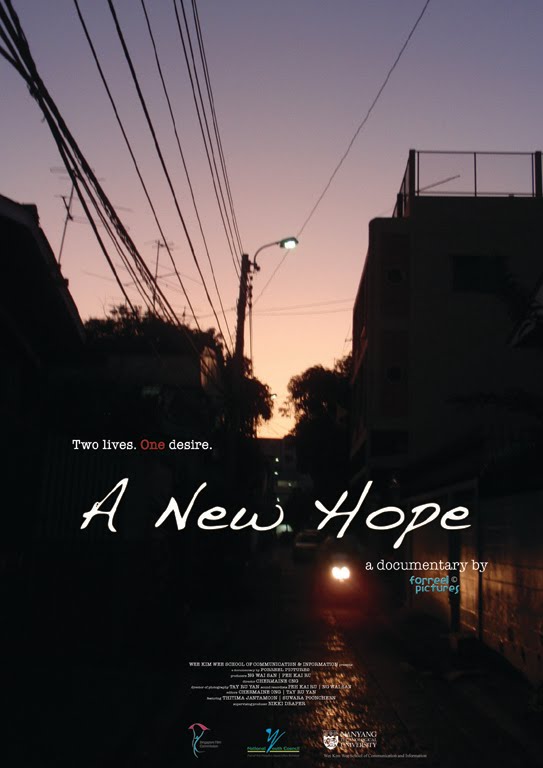
A New Hope (Dir: Chermaine Ong)
A simple talking-heads documentary about two HIV-positive people in Thailand. One is Su, a child who contracted the illness from her HIV-positive parents. The other is Pong, an HIV-positive mother who wonders if her boyfriend and daughter have it as well. Both are victims of Thailand's (ironically) successful HIV campaigns, which have brought down infection rates but stigmatised those who have the disease, no matter how they contracted it.

The film liberally stirs in interviews with both Pong and Su, as well as scenes in which Pong's loved ones undergo HIV tests. Because Pong and Su aren't closely related by blood or geography, this makes for a somewhat disjointed film when we jump from one to the other. I was surprised that the filmmakers didn't hinge more strongly on linking Su's testimonies of being bullied with the anticipation of the HIV test results for Pong's daughter (since a positive result means she would come to face similar problems). Though perhaps it speaks well that the filmmakers don't try to sensationalise these proceedings, and the very fact that these are real issues faced by a near-invisible group of people makes their film worthy of attention and praise.

Epiphany (Dir: Han Xuemei)
Oddly, the screenwriter of Epiphany isn't listed among those credited in the programme booklet, even though the raison d'être of the film is to show off his/her cleverness at intertwining characters. The film revolves around characters who get involved in brushes with death, or are losing their will to live: A girl stands on the edge of an HDB roof. An old granny walks onto a road to pick up her fallen groceries. A man has to leave his wife and daughter. Other characters include their loved ones and the bystanders to their verge-of-death incidents, and what's clever is that these roles sometimes overlap with the main characters as well. As we watch the film unfold, the fun is in seeing how it draws ever more links among the characters, and how it keeps throwing up morbid, fake-out "cliffhangers". I've lost track of the numerous screeching brakes and exchanging of glances, but my favourite was when something (or someone...?) lands on the windscreen of the man's car, followed by a quick cut to a different scene altogether.

The film's ending brings its three main characters together, though in a rather simplistic, oversentimental way, and it's followed by a John Milton quote—"Gratitude bestows reverence, allowing us to encounter everyday epiphanies, those transcendent moments of awe that change forever how we experience life and the world"—that seems incongruous in its profundity compared to all the pulp-fictiony stuff that's led up to it. The problem is that, even though the ending implies that these characters have found new connections and reasons to live, nothing has truly been solved. The film's messy web of estranged parents, children and lovers continues to linger...

Post-Love (Dir: Amanda Lee, Ng Xi Jie)
Post-Love combines A New Hope's under-heard voices of a minority group and Epiphany's show-offy fictions. This time, the interview subjects are the Singaporean elderly, but what's interesting is the topic: their thoughts on love. But then, a huge problem: what happens when your interviewees rehearse old clichés about genders (men are lecherous/women are menopausal) and then-vs-now ("kids these days" are more romance-focused and liberal)?

The filmmakers' clever answer is to amp up and play around with these clichés, so that they're both reanimated and not taken too seriously, even if we aren't learning much that's new and perhaps running the risk of reinforcing stereotypes. They do this by: 1) intercutting the interviews with exaggerated skits of old couples or to-the-camera exposés of "prostitutes", "PRC women", "potential suitors", etc., replete with deliberately unconvincing makeup and overbaked gestures; and 2) playing around with their subtitles. Notably, one interview involves a leering old man euphemising in Mandarin about lighting candles and popping champagne, while the English subtitles next to his head go wild with pleasure, revealing each word as he says it and popping into a bigger font-size at every insinuation.

And then there are the flashes of insight, as when one woman reveals that she's gotten used to loneliness, due to the impracticality of finding a compatible suitor at her age, and the inevitable mistrust that arises from wondering about his possible ulterior motives, such as money. There's also a precious moment framing an elderly couple sitting a width apart from each other on a couch, illuminated by the light of the TV, while the space between them fills with the exchange between the filmmakers that led to this moment: we learn that this was as far as one of them could get to having his grandparents be intimate for the camera. We may doubt the truth of the exchange, given all the pantomime that's come before, but if so it'd still be a nice and revealing enactment. Not everything works in Post-Love, but it's a grand display of documentarians working with what they've got, and it's dotted with moments like these that need no improvement.


Zombies Saved My Cold Dead Heart (Dir: Erwin Nah)
Neither as politically important as A New Hope or as conceptually creative as the other two films, nearly two weeks later Zombies continues to stick in the back of my mind, and not just because it was the last film of the night. It's more because the bespectacled dork and the girl he meets looked cute together, even though they seemed more awkward than they needed to because their dialogue was delivered too slowly and the pauses were too long. And that's before I've mentioned the content of the dialogue, in which they poke fun at the tropes of romantic comedies, none of which this film ever tries to subvert.

A rom-com like this is a cold dead proposition: you know exactly what it is, where it's going to go, and pretty much whether or not you're going to like it. Far too late into the film, there is a intertitle that pauses the story to warn "cynical viewers" and "art-house aficionados" that they're not going to like what happens next. It's a fair point, but really? Only now? What saves this film are not zombies (which it could well have done better with), but the fleetingly funny snapshots of our hero's imagination, and our sheer belief in the ability of heartbroken, well-intentioned people to find their way back into love. I wasn't unsusceptible.

Thursday, April 22, 2010

A 'Trilogue' on the SIFF 2010 Singapore Short Film Finalists (Act 2)


Here's the second half of Leon Cheo, Jeremy Sing and Colin Low's conversation about this year's SIFF Singapore Short Film Finalists! Be sure to check out Act 1 first!

Act 2

Jeremy: You know I feel the next short film "Life with Ummu" could have almost been lumped with the heap of non-finalists at first glance. It's got that "First Takes" look and feel. Not that "First Takes" showcases bad films but a number of its films are made by people who have a strong story or message but need not necessarily know how to stage it. "Life with Ummu" is mostly linear, to the point and effective. I could feel for once in the cinema, the usually restless audience sat up and kept their eyes wide open. It is a gripping story and it captured several gritty moments that I feel the director (a Chinese) should be given credit for being able to get a very pious Muslim (tudungs and all) family to bare it all.

The director also teased the audience by getting Ummu's younger sister to introduce her at the opening. So Ummu is immediately humanised before she makes her appearance.

Now given the fact that this could potentially be the film with the least creative merit, what do you guys think? I think the fact that I have a soft spot for this film comes from personal experience so I am a little biased.

Leon: I'm not sure if you want to say that "Ummu is immediately humanised". It's not like she's a monster. The subject matter, an autistic child, has immediate intrinsic value. It's something that is interesting to almost everyone. As an addition to the documentary landscape in Singapore, I think its academic "roots" are betrayed by how straightforward the style of the film is. Two scant passages of voice-over narration are really unnecessary and if taken out, would make the film less student-y. Nonetheless, "Life with Ummu" is heartfelt and illuminating.

Jeremy: Well, you can't deny there were a few compelling scenes where we see Ummu in some disturbing behaviour and what I was trying to say was that her sister's introduction set the tone right for getting to know Ummu, one of acceptance. Many 'humanising' is too sweeping as an adjective.

Colin: Yup. "Life with Ummu"'s central features are the shots of the autistic Ummu whacking herself, frantically rearranging the pillows on her bed, and screaming for no clear reason. These are easy for unfamiliar viewers to misunderstand, so it helps that we approach her from the perspective of her empathetic parents and younger sister, obvious though this approach may seem. Leon does notice some areas which would make "Life with Ummu" seem less amateurish, and this brings up a recurring issue I have with local cinema: the divide between fiction filmmakers, who often have great technique; and documentary filmmakers, who often have great content. Of course, there are notable exceptions in both cases, but I still haven't encountered a Singaporean fiction film with a narrative as urgent, politically and emotionally, as the ones I routinely find in any of our half-decent documentaries. Predictable it may be, but "Life with Ummu" is no different.

And "The 25th of Laura", the film after it, might just prove the other side of my point.


Jeremy: That's strange. Surely you mean the opposite right? I find "The 25th of Laura" the weakest in terms of getting its message or point across.

Colin: What I mean is that, counter to "Life with Ummu", "The 25th of Laura" struck me as emotionally detached and clichéd in content (a man moping over his muse—meh), but where technique is concerned, its attempts to innovate are evident. I suppose I was somewhat receptive to director Joshua Simon's willingness to scatter the logic of his film, even though I get that his efforts can be seen as total wankery.

Out of the slipstream bits I can still remember a good few: the estranging Korean voiceover, a figure swathed in light on a bare stage, an attempt at suicide gone absurd, a verdant if under-composed heaven sequence, and an afterimage emerging from a mosaic of photos. But I suspect that as time passes, the absent backbone of emotional meaning will quickly blot these images from memory, so I hope Simon follows this up by discovering a worthy story to which he can apply his talents—without, of course, being overwhelmed by the need to show off.

Leon: For some time, I've had this "fantasy" of making a film entirely in the French language, entirely for the sake of it. I suspect Joshua Simon has the same fantasy, and he fulfilled it his film "The 25th of Laura" with the Korean language. I can't really explain this fantasy but I guess it's a way to be different - call it a language fetish if you will. It's like how some filmmakers would use Cantonese, or like me, want to use French because I love how it sounds but can't really speak it. Maybe it's because of the potpourri of languages used in Singapore that affects how we deal with language in film. Most films are usually made in a language from their homeland. I recall a Singaporean short film made entirely in Japanese. Are Singaporean films the only ones which like to use non-indigenous languages?

I don't mean to digress: I think "The 25th of Laura" is a bit showy and there's certainly a level of competence. But enough of man-trying-to-find-muse stories already.

Jeremy: I know one local film dominated with a Japanese voiceover. It's "Cafe" by Kelvin Sng.

Actually Colin, many films can be very "wankery", or indulgent. But a good question to ask is what makes an indulgent film good and another bad? It is hard to say how to make an indulgent film good? Entertainment value? Shock value? Execution? Strength and tenacity of the director's vision? What makes one bad could be compromises in style and consistency. I personally find this film expressive but without bite or film grounding. And I agree that other than being stylistically enhancing, it tends to alienate the audience.

Colin: Well, it's apt to discuss those questions in conjunction with the last film, "Mu Dan". That film is also easily charged with wankery, and not just because it features a shot from behind of a man doing that very deed, his buttocks half-exposed, in its opening sequence (an homage to Sun Koh's "Dirty Bitch", last year's S'pore Short Film Award winner). It's also because the film calls attention to its surfaces: hostile cant-angled shots of an HDB lift lobby, a curiously empty and dark HDB unit, Chinese actresses exchanging a blonde wig, wafts of cigarette smoke, red peonies as a metaphor for youth.


I haven't even gotten to how whole scenes are shot voyeuristically, either from behind doors/corners onto unsuspecting characters; or into mirrors, so that we watch the characters' reflections the whole time. And that's before the film ends by re-appropriating a lover's song of heartbreak to the central situation of a divorced mom losing her son to a girlfriend. Cuh-reepy. I can excuse the odd lapses in directorial control, as in the two-person medium shots without any sense of theatrical blocking, because the rest of "Mu Dan" emanates discipline and oddball imagination at a level unmatched by its fellow nominees, save for maybe "Contained". What do you guys think?

Jeremy: Has anyone watched the perfume-ad-of-a-film A Single Man by Tom Ford? It is a good reference point for this perfume-ad-of-a-short-film, "Mu Dan". Coincidentally, both Lincoln Chia and Tom Ford are in fashion design. The eye for colours, texture and composition is meticulous in "Mu Dan", making it a real treat to watch. This film is a really a meeting of talents. Mesmerizing visuals aside, Li Xie, a seasoned actress really takes the film to a new level with her performance, blurring the lines of genre... very Freudian and very liberating to watch. The other aspects of the film are also equally competent.

I have to say it is my favourite of the lot because it eschews the traditional structure of a film, executes it well and does not rest on just stylistics. For me, it is the issue of sexuality which has the quality of being both very frivolous but affecting at the same time.

Am I just too beguiled by the prettiness of the film?


Leon: Compared to "The 25th of Laura", "Mu Dan" is so much more visually realised, and that's the strongest suit of the film. Each element in the film is particular and you can see the director's hand in every shot. I vividly recall the slow-mo shot of the girlfriend in a photoshoot, the mother's fractured reflection while smoking, and the boy walking through floating peonies. And this captured my attention for the duration of the film.

Colin: Well, to wrap up our discussion of this year's SIFF Singapore Short Film Finalists, I'd like to say that I've never been more rejuvenated by a slate of local short films that were screened in a theatrical setting. It's not an easy task to sit down to watch a continuous series of short films, since you have to reboot and prepare yourself for the next story just as the last one is wrapping up, but the diverse nature of these films makes the task that much easier, and so much more enjoyable.

Finally, a short look at our respective favourites:
Colin: "Contained", for sheer technical bravado
Leon: "Promises in December", for its emotional payoff (+ shout-out to "Mu Dan")
Jeremy: "Mu Dan", for being non-traditional, accomplished, frivolous and affecting

« Back to Act 1
________________________________

The Singapore Short Film Finalists were picked out of 70 submissions this year as part of the Singapore International Film Festival 2010, and will compete in the following awards categories: Best Film, Best Director, Best Performance, Best Cinematography, and Special Mention. The prize winners will be announced at the Silver Screen Awards and Gala tonight.

They will be screened again on Sat 24 April, 11.30am at Sinema Old School. Get your tickets!

Wednesday, April 21, 2010

A 'Trilogue' on the SIFF 2010 Singapore Short Film Finalists (Act 1)

Filmmakers, beware! What you are about to read is a heated conversation between three people about this year's SIFF Singapore Short Film Finalists. Don't feel alarmed if even some things like the glint of sunlight in a particular shot are talked about. We love details! Joining Jeremy and Colin is Leon Cheo, a guest voice for this SIFF season.


Leon, 25, is a director-writer-producer currently doing a BFA in Creative Producing with Chapman University (Singapore). His latest film, “Four Dishes”, has travelled to film festivals in Iran, San Francisco, Bangkok and Berlin. He never gets spare time but maximises it as much as possible by developing new projects. He just completed a new short, entitled, “Swing”.

Act 1

Jeremy: In the previous year's shorts finalist line-up there were one or two I could say without batting an eye-lid that I didn't like. I can't say that for this year. I think this is a year of moderates - nothing too bad and nothing good enough to make you think we've found another poster boy or girl. Adding to this is the range of genres in a single competition. They are namely comedy ("Que Sera Sera"), animation ("Contained"), kids' drama ("Sunrise"), drama ("Promises in December"), documentary ("Life with Ummu"), experimental ("The 25th of Laura") and what I call the perfume ad whimsy ("Mu Dan"). It is strange how there is a token from every common genre. I am still thinking about my favourite although I can already hear some people rooting for "Que Sera Sera", "Contained" and "Mu Dan".


Let's talk about them in order, starting with "Que Sera Sera". Ghazi has a knack for taking the cheeky out of many things. It is both witty and adorable how the inner-voice (VO) sounds like a rebel while the outer voice is a whimper. As a result, it makes the boy seem vulnerable which I feel is key to making the audience sympathise. I cannot forget the little presentation he did to his teacher alone. It's a classic for sure.

Colin: What a sweet film, and how cheeky indeed that it achieves this by being as profane and borderline racist as it is! A lot of this can be attributed to the disarming figure of Syahidi, who plays the chubby kid that is the film's centre; as well as the ever-present voiceover by (I presume) the director Ghazi himself. Like I noted, the voiceover can be rather profane, at one point even getting into a chant of words I won't repeat here, while the sanitised subtitles keep swapping between "Dick." and "Head." It also tempts charges of racism, despite disclaiming that "I am not racist", when the kid, late for school, bumps into the Indian discipline master at the school gate. It helps, of course, that I know the actor playing the discipline master is a sporting friend of Ghazi's. But what saves all this even more is (as you've alluded to, Jeremy) the disparity between the cursing voiceover and the boy's sweet and natural disposition, which ends up making the former seem more harmlessly amusing.

I also loved that, like Philothea Liau's "Brazil" (where the value of an eraser reaches absurd heights), "Que Sera Sera" manages to evoke nostalgic details of past school days, and appends to that a kid's perspective on those details. I'm referring here to the discipline master's punishment, so idiosyncratic to its time and place, and so random and unfitting to the problem; and to the boy's reaction, never questioning the punishment's logic, but troubled by an unrelated set of problems that it will cause him.


The only complaint I have is that the film contrives a tummyache just so that the main character will miss his class. This makes sense logistics-wise, since you'd only need to cast the teacher and none of his classmates; and it helps the emotion of the scene where he presents his ambitions to the teacher alone, since it's no longer a chance to show off to peers but a more intimate reveal of his dreams to someone who seems to care (which prompted another filmmaker during the Q&A to ask Ghazi if he ended up marrying that teacher, heh).

But since the rest of the autobiographical film feels light and frothily believable, the tummyache could have been better foreshadowed so that it wouldn't seem like a mere storytelling device. For instance, his voiceover could have mentioned that he eats just about anything (and showed him eating something bad), or he could have been filmed eating just before he was made to run laps around the parade square. A minor point, really, when the rest of the film manages to be so funny, truthful, and above all sincere.

Leon: I agree with Jeremy; there is no outstanding short film this year. I like certain things about the films, and also dislike certain things. With "Que Sera Sera", I think it's great that we have Malay voices like Ghazi in the Singapore film landscape. The casting of Muhd. Syahid is a wonderful choice. He is cute and immediately endearing. Because of him, I forgive the toilet humour. The crude and vulgar stream of thought of the boy is hilariously sharp. It's nice to have a comedy when everything else is more serious and dramatic.

Jeremy: Now that you brought up the tummy ache, I am starting to see it as an narrative excuse. But hey, maybe let's just imagine all of these, tummy ache, profanities is Ghazi! Haha. It is meant to be a personal film anyway.

I sort of had an inkling this would be the audience favourite but my loyalties started to sway when I saw "Contained". It is undeniably meticulous in its execution. I must say I do not understand the animation techniques well but I tend to judge the skill by number of frames. In other words, it has to move a lot! I see a lot of very shoddy work from students where you can tell the figurines/characters have very limited lines of motion. In this, the motion is fluid and there is always something surprisingly in each scene. I especially the part when the studs and crazy thorny things were popping out of his head! I also must say the sound design was spot on!

Leon: The technique in "Contained" is evident. I don't know what you called them in stop-motion terms but I really like the way shapes evolve into other shapes. The creepy visuals and textures of this short film reminds me of Jan Švankmajer, probably the most influential artist in the stop-motion world. Every year at SIFF, there is always one animated short and the technique is usually excellent. Now, if only Singaporean animators would begin tackling more narrative-driven animated stories - I think that would be truly a treat.


Jeremy: I would say give us something different this year - let "Contained" win! At least it sets a new precedent for animation.

Leon: Maybe they are not winning because they aren't as dramatically fulfilling as the live action shorts?

Colin: I, for one, would have no problems with a win for "Contained". Great stop-motion animation nearly always catches me in the throat, just for the sheer technical bravado and patience involved, and "Contained" managed that early on with its depiction of those plasticine waves sloshing.

But despite the difficulty of crafting those wide shots of the island, I find myself aligned too with Leon's point about the need for more narrative-driven animation. That may explain why my favourite scenes of the film are those set in the dark, tight confines of the hut interior, where the main character tends to his dying flower. There's a surprising rage to his attempts to save the mere appearance of the flower's health, culminating in that sad image of the re-attached petals blowing off the flower, leaving strips of cellophane tape flapping in the wind. I love that, while most films would opt for making a similar character pitifully emo, this film drives him insane instead—and breaks out that madness visually in its memorable final shots.

The theme of being left alone carries over to the next film, "Sunrise", about an eldest son who has to care for his younger sisters after their mother leaves them for work. It's the most "foreign" film among the finalists, filmed and set in Cambodia with the orphans of the Sunrise Children's Village, which may explain why I found it hard to identify with it... although the languid first half may also be to blame. What did you guys think?

Jeremy: Two years ago, there was a film in SIFF called "To Speak". It was about two kids wanting to own a house and overcoming all odds. My first impression of "Sunrise" is that this is yet again a film that exploits the 'easy abundance' of stories in poverty-stricken Cambodia, like a kind of "poverty voyeurism". But compared to 'To Speak', it has more cinematic value and a stronger narrative drift. By the way, I love the framing and the lighting in the house scenes. Evokes a languid feel and also enriches the mood in the house. What i really take away from this film is the temple scene in which the boy stoically speaks to the monk to arrange for his mother's funeral. The naivety and the innocence of the boy just captures me!

But what I don't like is the length. I realise nicely-shot scenes have a short shelf-life on film. Never repeat them too much which "Sunrise" did. There is also what I would call a paradox of novelty. By this, I mean if you start your idea in a seemingly colourful place, you may end up with something actually very boring and if you start in a more ordinary premise, with a little thinking, you could conjure something actually very exciting. Hope you know what I mean guys...


Leon: I think films like "Sunrise" get stale very quickly. I could do with a bit of trimming on the running time. I mean, you see this kind of film every year at the festival and there is really nothing new or interesting to be seen here. I wonder how/why this film was selected...

Colin: Yeah, I think we all agree on the slowness of much of the film. There's an approach to observational detail (e.g. a shot of a plastic scoop bobbing in a full bucket) that works when these details are tethered to a narrative throughline, and I don't think it's achieved in "Sunrise". To be fair, I like the same temple scene that Jeremy does; it reminded me of Kore-eda Hirokazu's Nobody Knows (Japan, 2004), which also involves a kid having to step up to being an eldest sibling, an adult, and even a surrogate parent, long before he ever deserves to.

Jeremy: You know, I have a feeling the judges might just give the prize to "Promises in December", the next film. It's got that award-worthy genre and form, in other words, it's a 'serious' film. You've got a plot that has a historical and social context. The issues are well-thought out, the acting proficient and you've got it all geared up to look like it wants to be taken seriously.

So where's the catch in my comment? The catch is I feel a little uncomfortable with how the film could be a little unorganic and scripted. The opposite of that would be Ghazi's Que Sera Sera. I also don’t like how the feel of tsunami is being evoked. It somehow feels quite artificial. I also had an issue with Raymond Yong’s TV-style acting.

Leon: I really liked the film. Though the early scenes between the taxi driver and the maid are a bit stilted, I enjoy the parallel and juxtaposition of the main characters. As the film goes along, you wonder where it's going. Then, the final revelation comes and it is well set-up: you get scenes of the taxi driver at a columbarium and you wonder why. The pay-off is good and the non-linear play on the plot is effective. I connected with this film the most. I want to see more of Elgin Ho's films.

Colin: I'm divided on "Promises in December". For starters, while the taxi driver and the maid are in danger of being far too common character types, the film pairs the two as leads rather fruitfully. I like that it opens with the maid on her phone, shaping her as a person with an imaginable life back at her Indonesian home, without abstracting it into a burden as many migrant films do; and I like that her employer family's daughter for whom she makes breakfast actually seems appreciative of her work, when so many other filmmakers want to harp on the flashpoint of abuse.

Instead the film makes the taxi driver the worker-class character who is beset with problems. His HDB flat and packet char kway teow are clearly meant to contrast the landed property and pancakes where the maid works, and yet the film does this while skirting past a lot of the cheap oppositions that are one of my pet peeves about local film. I suspect it works because the maid doesn't actually live there, making the contrast more complicated, and because the film doesn't demonise either way of life.

This leads to what is absolutely my favourite shot among all the finalist films: when the maid is in the driver's taxi, he tosses off a comment that she probably wouldn't want to live in Singapore if it weren't for the pay, right? As he says this, we get a shot of the maid looking out of the cab window, on which is reflected a row of HDB flats, and she is silent as they drive by. It's such a profound shot, capturing the perspective of a woman who probably dreams of a life that the man is disavowing, even as we acknowledge that her six years' work in a landed property would likely misrepresent life as he knows it.


And then the film has to spoil that by contriving an explicit link between them, of all things by invoking the Asian tsunami of 2004, and delivering "justice" to each character. Not only does the link make the whole setup feel artificial, it's a little unfair to use a senseless tragedy like the tsunami to give fictional characters grief, especially if it's a fake-out or if it's to "punish" a character for not being understanding. "Promises in December" does both, and I haven't even mentioned the awful closed-captioning on the film, which mars a potentially horrifying tsunami recording over a black screen with the words "[woman screaming]". (Or that, at an earlier point, reads "[phone vibrates]" even though the onscreen phone isn't visibly vibrating.)

Jeremy: On hindsight and after this discussion, my view of "Promises in December" has shifted a bit. I agree with the favourite shot of yours Colin. It carries the film's spirit of irony quite cleverly. Maybe I didn't pick it up at first look because the HDB flats' reflection was whizzing past the window surface too quickly. They could have cut to a point-of-view shot of the flats instead. It would have amplified the message. My conclusion about this is I like its idea but I would have preferred a less deliberate form.

Continue to Act 2 »

Thursday, March 4, 2010

A Dialogue: Panasonic Digital Film Fiesta 2010


Nine promising filmmakers created their films under this year's Panasonic Digital Film Fiesta competition. As the judges make their tough decisions towards the Awards-giving on 11 March, here are some views from the floor from Colin and Jeremy.

Colin: Let's kick off with the two shortest of the Competition Films: Darren Tan's 31.12.2009 and Goh Kun Lei's The Sight of Music. Both clock in at about three and a half minutes, and each work out a spare but evocative premise. 31.12.2009 reminds me of Paranormal Activity, with its static closed-circuit TV camera, and I'm sure it's trying to be a horror film: it's capturing a rape along a deserted street alley in a long shot, all in black and white. And then The Sight of Music switches gears by blooming into colour, another mostly long-taked film about a busker playing the erhu, and the boy appreciating his performance. What did you think?

Jeremy: I was happily being entertained by Lee Chee Tian's Beam and Mohamed Tasshir's CheckMATE until 31.12.2009 set my mind off in a different level engagement altogether. Despite this being a Panasonic Digital film competition, history has shown that the judges do not really care even if the film does not harness the most of what Panasonic cameras can do. They mostly care about good films. Like the year Victric Thng's The Mole won. It was 80% paper cut animation. So the Blair-Witchy 31.12.2009 did a good job in a short time. The Sight of Music was also very impactful but in a more subtle, graceful and cinematic way.

Colin: I agree that 31.12.2009 is quite different in register from almost all the other films in the competition, because it's trying for a rather dark mood. I think the film overdoes its message a bit by having that one curious person taking a phone-photo of the rape from behind the corner, and then punctuating the whole film with the word "apathy" — as though we don't get the point, or as though avoiding the scene of a rape is a fundamentally similar scenario from the rave-scene molest at Sentosa. But I credit the filmmaker for conceiving the idea of capturing this scene in a single take, to force us to question how much we can take as a passive watcher of the film.

Jeremy: Agreed about the spoonfeeding. On a wider note, the films belong to such different schools and disciplines! There are the child motif films like Beam and CheckMATE. There are the statement mini-shorts like 31.12.2009 and The Sight of Music. There are absurdist, surrealistic ones like Grieving Conscience and Maybe She Loves Everyone. Then there the standalone ones that make judging like comparing apples to durians. There is heartbreaking a la Mediacorp father-son drama Homeless in the Heart. It evens sounds like Channel 5! Then there is impressionistic Tear Love Smile. Lastly, there is the rather kooky and somewhat clumsy Ain't It All.

I don't envy the judges.

Colin: Actually, I think Homeless in the Heart fits nicely into a category with Beam, CheckMATE and The Sight of Music as sentimental pieces whose narrative structure is never really in question. Of course Homeless is the least compelling drama of the four, since the blurb already gives away the "prodigal son + unconditional love" ending, and the father and son spend most of the film moping. The intrusive voiceovers are obvious signs that the director doesn't trust his actors enough to convey the feeling of his scenes, too. But I'd like to single out an ambiguous note in Homeless that I enjoyed: At one point, having frustratedly loaded the washing machine, the father pours a capful of detergent, and then holds it for a while, frowning. The film then cuts away to him hanging up the clothes to dry, skipping over his decision to continue washing the clothes instead of attempting suicide. Did you interpret this scene in this way? Which of these four films did you like best?

Jeremy: No, I did not interpret it in this way. Maybe because I know Yew Yee. He's not the subversive type who would create disturbing moments (Just my very surface assessment of a friend). I liked CheckMATE the best because it captures unabated spontaneity and morsels of truth. You don't feel the actors are sweating out in their roles. Both old man and boy are like matchstick and fire. They just (pardon the cliché) light up the screen! Beam was heartwarming but old-school and very My Secret Heaven (Sun Koh) and Di (Michael Kam). But it's just new talents in old clothes (Yup, the singlet is like a instant emblem of "HDB whimsy").


Colin: Can't disagree with your assessments of either film. I'd say that Beam is the most sturdily constructed of the four sentimental pieces, and the bulk of it is My Secret Heaven with the parental figures swapped: now it's the father who is brutal and authoritative, and the mother more sensitive and concerned. I think it's possible, and desirable, for short films to get past this sort of black vs white shorthand, and I'm sorry that Beam succumbed to it. I did enjoy the transience of the unknowable friendship at the story's core, and I was grateful that the flash-forward to the main character's adulthood didn't ruin it by having him discover who it was.

And you're right, too, about how wonderfully natural both actors in CheckMATE are, though I didn't get how the crucial move of the title fits into the story. Does it mean the boy has outsmarted the old man? Or that the old man is, in fact, destined to lose? For me, that final move is a tiny sliver of mystery in a film that's otherwise didactic.

But that mystery is nothing compared to what some of the other films offer! Were you surprised by Chantel Li's Ain't It All or Andy Chung's Grieving Conscience, which both started out straightforward only to get more and more bizarre? Or were you more intrigued by the upfront enigmatic structures of Wesley Leon Aroozoo's Maybe She Loves Everyone or Ho Wen-Shing's Tear Love Smile?

Jeremy: These are certainly the bolder and more challenging of the cohort. Kinda shows the competition places a high premium on the abiliy to push boundaries. But challenging can also become painful. This is where I see a dichotomy between the four. Maybe She Loves Everyone and Tear Love Smile are impressionistic and cryptic but you know the director is persistent in his/her vision. Almost like someone who is fervently selling you the idea that the world is actually square: it can suck you in if he hits the right keys. The other two work less well because they rest on less sturdy vision. They seem less coherent and make it more liable to being questioned on its artistic choices. So it seems directors sometimes have to be like professional con-men; they can get away with hogwash if done well.

Colin: "Well done" is a good way to NOT describe Chantel Li's Ain't It All, which is least professional-looking film of the bunch but, mercifully, not the least interesting. Despite the amateurish editing and acting I'm rather impressed by how brazenly the film barrels from one plot to another with even less connective tissue than TalkingCock the Movie: a cyclist who gleefully picks up a vulnerable woman → a copywriter's audition → a snatch theft → a self-defense training montage (with typically embarrassing results) → a mutual, non-sequiturish taunting session with a training mate → that training mate walking away from being bullied. W-T-F? I loved how trainwreck-y the whole thing was, especially since the alternative wasn't another hokey sentimental film, and I'd be interested to see what Li does with more professional resources on hand.

By contrast Grieving Conscience is quite staid: tastefully art-directed and acted in that fake-aristocratic manner that Singaporean productions of imported plays tend to be. Not too surprising, since the script seems to have been based off Roald Dahl's short story William and Mary, about a long-suffering wife who resents her controlling husband.

Finally, I want to single out Wesley Leon Aroozoo's Maybe She Loves Everyone for praise. Heartbreak films are difficult to make, because the sentiment is so universal that the director must have a creative vision so that he can bring something new to the table. The structuring device of the learn-French CD that spouts off phrases that get more and more intimate; the motif of the thankless grass-cutter; that cross-dissolved shot of the bound ex-girlfriend being swept by the grass-cutting device; the final slow-mo, low-res take of the girlfriend's smile — all struck me as very original. The only other film of Aroozoo's I've watched is Lion's Pride, and after this I can't wait to see what else he might do.

View all the Competition Films at the Digital Film Fiesta site. Competition judges include filmmakers Tan Pin Pin, Royston Tan and Kat Goh.


Additional comment from the judges (April 2010):
The judges of the DFF noted that Andy Chung's Grieving Conscience was too much like Roald Dahl's story and disqualified this film from the competition; it was not considered for any prizes. The judges want to stress that filmmakers must give credit where credit is due, and plagiarism is unacceptable.