Showing posts with label Writer: Melody Chow. Show all posts

Wednesday, April 13, 2011

Production Talk - "Flux" by Nigel Heng


FLUX is a dance film that basically has this housewife-alien-dancer-person that performs a set of movements for the camera.
The film is done in collaboration with local Choreographer Elysa Wendi. I wouldn't call it an experimental film although a lot of people seem to see it that way. Not that I have an issue with it, but I just always saw it more as a straight forward dance film with a sort of Music Video aesthetic.

Although the film itself is not experimental, but the process definitely was. We made it such that prior to shoot day, there was no dance, no music and no shot list. Cause of that, there was a lot of adrenaline and we had immense amount of fun.

Came time for post production, I had to edit the dance with no music. Likewise, You And Whose Army (made up of local musicians Adam Shah and Bonk Khoo) had no dance to score to. We had to slowly home in on each other with every draft we sent. (Roughly a dozen)

Lastly, as opposed to coloring the film in a video editing program, we did it with a stills photography program. Which meant that we had to grade each shot, frame by frame. I'm still not sure why we chose to do that to be honest. I think something short circuited in us after those twelve aforementioned drafts.

Why did you decide to direct a dance film? Is there a personal significance to the genre?


We were supposed to shoot a music video for this certain module in class but I wasn't too keen on doing a band video. Not that I have anything against it, it's just that I didn't feel like doing it at that point in time. Elysa ( The choreographer for Flux) came down to ADM to give a talk about what she does and dance films in general. She was looking for collaborators and pitched this one idea she had floating about her head. The moment she said the words "house wife" I doodled a drawing of a house wife in my falling-asleep-at-lecture doodling style which had a bob hair cut and Tin Tin eyes. I stared at it for a while and thought, "Wouldn't it be cool if we could get the dancer to look like the drawing in real life, down to the Tin Tin eyes?"

But well, to answer the question more directly, I decided to do it cause I thought it'd be a lot of fun.

What was the inspiration behind the film?

I had this one project that I was stuck with in post-production limbo for a really long time. That short film is pretty long, quiet personal and meditative. It drove me crazy. There was so much suppressed energy that came from that project. I felt like I needed to jump around and do really fast cuts- or just do something weird and fun. I was feeling really down about it (because it was just really draining)  and I needed a new project to sort of get the groove back.

So when Elysa came along and described this image she had of a woman dancing by herself when she's alone at home it just sort of blew the flood gates. I went up to her all excited after her talk and promised her a treatment in 2 days time.

In that sense, I guess Elysa was the inspiration.

You've stated that the film was not intended to be experimental, but rather the process instead. Why so? 

Because instead of locking down things like music dance, location and all of that, we spent most of the pre-pro period just jamming. I threw a few Chris Cunningham videos Elysa's way and she introduced me to Pina Bausch and the DV8 Dance Company. Adam and Bonk ( You And Whose Army) were throwing me samples and random doodles they did on Reason. I would then pass that stuff to Han (The cinematographer for Flux) and he'd let me know if he thought it was cool or if it sucked.

Basically stuff was just ping ponging back and forth so that we could slowly lock in on an idea together in the most organic ( and democratic ) way possible.


On shoot day, we made it such that there was no dance, no shot list, no music prepared. The situation went something like this: I would choose a space in the house, Elysa would walk in with her dancer and choreograph and rehearse within an hour and a half. At which time the crew would just be chilling out. After the dance is done, I'd gather everybody and we would watch it together . That was really interesting, because the dance was conceived, rehearsed and performed to an audience -then reinterpreted for camera in under an hour and a half for each scene.

Yi Xin the dancer would then be hurried off to do her "Tin Tin eyes" makes up which usually takes 45mins to an hour. At which time I would work with Han on how best to shoot that particular which usually takes 10 minutes. After the camera gets locked, Jac Min ( Benjamin Tan) would then take about 30 mins to execute the lighting. This would then be repeated for each scene. It was really loose but extremely tight at the same time.

In post,  there was this weird Catch-22 of no music cannot edit, no edit cannot make music, we just kept revising and revising until we got it right. It took me and the musicians about 10 drafts ( of sound and image) to arrive at the final cut. 

While preparing for/ shooting Flux, what were the challenges you've faced? How did you managed to overcome them?


There was just this one hiccup where the Liquid latex got shipped to singapore late. But other than that it was quite okay. 

You've mentioned earlier on that during your post-production, you guys utilized the stills photography program instead of the usual video editing program. Why the choice?

Someone from my class mentioned that Photography programs handled images in a way which was much more sophisticated than your regular video editing software. So I thought I'd give it a go. It was nice because, we didn't have enough time to set up the big black cloths to get enough negative fill for the wide shots, so I just burned them in manually with my mouse frame by frame.

Was the result worth the time and pain? Nope. On hindsight I could have just done that kind of thing with a couple of vignettes in Apple Color. It was roughly 7480 - something frames. That gives you a lot of time to reflect on your own foolishness. Never again. 

Most importantly, how did the budge for Flux went? What about getting the crew too? 


Because It was a school project and I was still in school, the crew was made up of my film seniors, juniors and (My non film school ) friends. The budget for the film was about $500. We got all the grip/ lighting stuff from school and Han had his own 7D, so we didn't have to rent anything other than the Van. Food was made by my father ( The best bee hoon you'd ever taste. ) 

$500 just about covers the wardrobe, van rental, wig rental, 2 jars of latex and little bit left over for misc stuff. 

Any future projects?

I'm working on my thesis film right now. It's a short Sci-fi black comedy about a guy who's trying to save his failing marriage while fighting his growing attractions for his new second-hand android.

It's called "Lucy" If anyone wants to find out more you could visit our facebook page!  http://www.facebook.com/Lucythefilm

Sunday, April 10, 2011

Production Talk - "Wake" by Atsuko Hirayanagi

Wake was Atsuko's first year project at NYU’s Tisch School of the Arts, Asia. The project had to be an adaption of a news article, which led her to pick a Japanese article from 2004. It talked about a skeleton of a man being found in an abandoned apartment building situated in Tokyo that was about to be demolished – the person had been dead for 20 years of a natural cause. Thus, Wake was the result of her curiosity as to why no one had bothered to look for this all of those years.


"I first adapted the story into a Japanese script, but since we had to shoot in Singapore, I changed the setting to Singapore. While location scouting and speaking with HDB management, I realized that it would be very unlikely to find a dead body left unnoticed in an abandoned building in Singapore for more than 6 months, let alone for 20 years. At the end, I decided to suspend this portion of reality, as I felt that the spine of the story was fairly universal. I also found that there were many similar cases of bodies found in abandoned buildings and houses around the world, including in the US, Chile, Italy and Romania. In one of the cases, the body was found after more than 30 years.

The three and a half day shoot kicked off in March 2010 at an HDB in Jurong that had been empty for six years. It was actually spooky because there were still traces of people’s lives left behind, from posters and scribbles on the wall, to some furniture, dishes and kids toys buried in dust. We thought that we might really find someone dead there, as there were hundreds of apartments and each block was like 20 stories high.

The rest of the shoot was more ad hoc and a bit last minute, with the generous support of a funeral parlor and our cinematographer, whose apartment we literally trashed. This is because I wanted the protagonist, Mike, to live in a “garbage castles” (Gomi goten)—which is a recent phenomenon in Japan, some people bury their houses from inside and outside in clutter. I wanted Mike’s character to be a hoarder, who is stuck in the past and afraid of letting go. OK, I won’t give the story away. I just hope that Wake captures at least some moments that resonate with people, regardless of where they live."

You mentioned that your first year project had to be an adaption of a news article, so did you already had the intention of looking for news article regarding undiscovered corpses or did you happened to stumble upon them? Why the choice of undiscovered corpses?

I stumbled upon the article about 6 years ago when I was writing a Sci Fi script of similar topic. It was about a son returning home after a long absence, and discovering that his mother was actually an alien who had taken over the body of his long dead mother. I remembered this article, so I used it.

Speaking of undiscovered corpses, which would mean that you need a long abandoned place. So how did you go about scouting for locations?

We spent weeks location scouting, sometimes even sneaking into places (shh) or taking photos of abandoned houses from nearby rooftops. It was very hard because in Singapore they are always building new buildings, and they don't let old buildings just sit there. When we were getting really desperate to find the right place, Mike (the lead actor) told me about this HDB, which he had shot something at weeks prior. It was perfect. The HDB management were very flexible with us as well. So it was serendipitous.

How about casting? Did you already have a 'Mike' in mind?


Mike's name was referred to me by a friend, who had worked with him. I called him in for the audition, and during the audition, I asked him many random but personal questions. One of the questions was "what do you regret most in your life?" I thought that regret was a very important element of Mike's character, which brought to him to the 'current' state in his life. The audition was an emotional one. The way Mike told me a particular story, made me feel that he was it for the role.

What were the challenges you've faced from the pre-production to post production? How did you overcome them eventually?

The lack of pre-production time was the biggest challenge. Since this was a school project, we as a team of five were assigned a production period of 20 days, so each of us got 5 days (2 days of pre-pro and 3 days of shooting) for our films. The groups were assigned randomly, and we rotated in our roles, from DP to AD to Sound to Grip to Writer / Director. So basically you have no time to pre-pro once the production period starts, because you're constantly working for other classmates. I was missing a few actors until a night before the shoot, so it was extremely stressful. You're also physically getting really exhausted. You just have to have faith that it will come through, and it does, usually : )


On post production, Freddie Yeo from Infinite Frameworks was extremely helpful, from color correction support to introducing me to sound editors. Editing your own film is really hard, especially after getting a lot of different, and sometimes conflicting, feedback. You also become so close to it that you start losing perspective. It's good to have a deadline, then you can eventually let it go.

Did Wake turn out the way you've envisioned it to be ? If not/so, is there anything you would have done differently?

When I watched it recently at the screening of the Singapore Short Film Awards, I saw more holes than I remember seeing last year : ) In most part, Wake did turn out the way I envisioned it to be, but I really wished that I had more time to prepare. It would have been great to have more time for pre-production. I would have liked time to rehearse with actors and block the scenes as well. It's all a learning experience I guess. You can grow from it. Because of what I went through with Wake, I felt like I was in much more control during my 2nd year film production, which we just shot over the winter in Japan.

Future plans?

I'm in the middle of post production for my 2nd year film, so finishing it would be the immediate future plan. Then the next project would be my thesis, then you graduate, then your first feature... It never ends. Hopefully I grow as a filmmaker each time.

Tuesday, April 5, 2011

Production Talk - "Scot Free" by Chia Pei Zhen

Scot free is a final year thesis film made by a group of students from Ngee Ann Poly School of Film Sound and Video in year 2008.It was completed in early 2009. it was the first student short film to undergo 2k processing courtesy of blackmagic design. The shoot took like 12 days, was shot on 16mm film. The film has participated in the the bangkok international student film competition ( it hink thats what its called), 2010 singapore short film festival (panaroma short selection), 2nd vancouver singapore film festival and was recently nominated for 3 awards at the 2nd singapore short film awards.

The shoot was shot all over singapore mostly on a 5 men crew and a truck full of equipment and it was mad tiring. The idea of the film was conceptualized and set in stone from an accumulation of different ideas over 7 weeks which basically started when we were thinking, "what if we made a film about 2 foreign bagpackers?" that was where things get as crazy as the film gets.

What was the idea behind Scot Free?
Why we got to the point of making scot free was that we were reaching our final year in Ngee Ann FSV and we needed to do an industrial based project or be attached to a local production house for that semester. Groups were formed and we also formed our own group. So we started to write. From the very start, Pei Zhen was quite adamant on shooting something with foreigners in it lol,(all her projects have foreigners in it). Ideas were scattered, it was a potpourri of a random influences, experiences and ideas as evident in the film. If my memories do not fail me, i think Pei Zhen said something like, "maybe lets do something about murder" which might seem lame because student film plus murder just seemed like a inevitable concoction for celluloid diarrheoa. But somehow, both Pei Zhen and me were confident that we were able to pull of a simple tale that has murder in it. Our DOP shawn who has previously lensed our projects was down with us. Even though he probably only seen like 10 films in his life and quote the cinematic awesomeness of "no country for old men" everytime we discussed shots, he is the best DOP in the school and had a clear grasp of where we were heading visually.

What inspired you to write Scot Free?
We had scattered ideas before everything was real solid. Pei Zhen wanted to make a film about backpackers in a foreign country. Another major inspiration was an experience of me in Germany: I was sleeping in my room when i heard knocks on the door, without thinking much and my spectacles, i opened the door and this drunk guy come in shuffling things, checking my bedsheets and my toilet like he is looking for something real important, he then left the room as i stood there half naked. I think that anecdote sort of became a catalyst in our writing process. We were also inspired by Pedro Almodovar's Volver quite a bit on how they were able to make a film with murder in it and yet elicit so many different tones and emotions with these great female characters. And when we thought of murder, we thought of durians and how it rubs tourist off in such a hilarious and frenetic way and thought it will be freaking badass if a durian was a murder device. Its that something a million people probably thought off but never thought that combination will ever see the light of the day.

How did you managed to cast for the main leads? Did you already have certain choices in mind?
It was hard finding the leads, we tried different places, AADB for one. We were so desperate to a point we were like, "we'll find any actress who is white!" We tried the Alliance Francais but it failed as well, until we finally came across the French Association of Singapore. This lady by the name of Emmanuel something who helped us to send the notice out. That is how we got the 2 actresses. We were looking for younger actresses initially, sort of like those adventurous types that love bali with their lives on the line. But we found our leads who were in their 30s and it had a better feel.

What were the challenges you've faced from pre-production to the post production? How did you overcome them? Especially when the film is in french, how did the editing go?
In Pre-Pro, for one, scripting was a problem but nevertheless an immensely enjoyable process. In Hindsight, its amazing how we trim a 30 page draft to a 17 page one. Finding our actors were hard as well, all those roles. It was hard to cast the 2 leads and it was hard to cast the murdered guy as well, i remember after a series of email back and forths, we casted him in a very james bond espionage manner in an MRT train where we were constantly tracing him until we finally found him. The locations were tough as well, most hotels couldn't care less about allowing people to film. My dad helped alot in helping to find the bangladeshi workers.

When it came to production, the scheduling of the actor's dates was insane, the one who acted as sabine is a pilates/dancing instructor and the whole schedule was pretty much based around their schedule. On another hand, we were underhanded like mad, we were pretty much a 5 man crew all the while, we did makeup, props, basically everything ourselves. The locations also tested our limits. The beach for example which looked so cool in the film was insanely hot in real life, it's like we were filming a sun commercial. Some of the locations can be quite a bitch as well. The indian restaurant we were filming at was all nice when we started but when we took abit more time, they looked like they were going to bodyslam us or something, one of their shoddy workers that resembled a pirate even wanted to extort us behind his boss's back. Some white expats also messed around us when we were shooting at clarke quay, bunch of jerks they were. The fact that they convinced the people around them to cheer their childish behavior really reevaluated our faith in the people of our country at that point of time.
When it came to post-pro, Pei Zhen got to step in to fill the shoes of the editor position because our editor who did less than filling half a log sheet on set was more concerned about becoming a runway model and getting people to vote for her as miss chinatown, lots of unnecessary irresponsibilities coming from her.
The difficulties of editing wasn't really that much on the fact that the film is in french but more like us trying to put these scenes together seamlessly and making sure that we were able to bring the story out.

Has the film turn out the way you have envisioned it to be? If not, what would you have done though?
For the most part, the film turned out how we planned, but it would be better if the quirk and randomness in the film was balanced with more grounded reality.


Any future projects?
As of now, Pei Zhen is studying in Concordia Montreal so i guess she should be churning out something soon. Other than that, the rest of the crew is still in NS .

Click here for the article Kodak did on Scot Free!

Saturday, February 19, 2011

Pretty Junk for Mise En SIN

We (Jeremy, Grace, Melody) braved the rain and the crowd to pick up some pretty-looking junk for the exhibition Mise En SIN. It was tough finding pretty things among the heaps of dusty hand-me-downs. The most interesting thing on display was actually a dog, which attracted a crowd. We were speculating if it was on sale!
Grace waiting for directions
Melody checking out old clothes
Shooting paraphernelia
Melody found a 'basket suitcase' - good for running away or eloping!
Jeremy's 'auntie' instincts rise for the occasion.... :P
You wonder how these shopkeepers bring these things in and out everyday. It's back-breaking.

We found another oldie, but no la.... not quite for going for the period look for Mise En SIN.

Friday, November 26, 2010

Fly By NIght Video Challenge 2010 - Chapter 1

The time was 2330 hrs, we had not decided on the 'big idea' yet, but glad to have air-con.

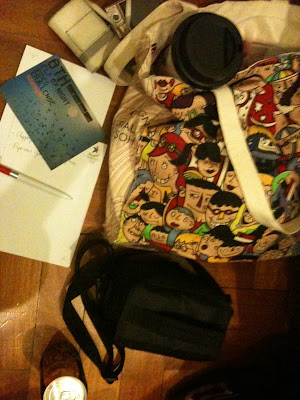
Fly By NIght Survival Kit - instructions, camera, tote bag and coffee

Melody brings on her Production Assistant skills from Ho Tzu Nyen's 'Endless Day' on to the SINdie production set

Darren has an idea!

Tuesday, November 16, 2010

Production Talk - "Sisters" by Lincoln Chia & Michael Tay


It is customary that during a traditional chinese wedding, the bride usually hires a group of close friends to be her 姐妹, internationally known as bridesmaids, to come and tease the groom. In this short film, the role of 姐妹 is portrayed in multiple ways, such as the sisterly love between mother and daughter, brother and sister, nephew and auntie, niece and auntie etc.
On the wedding day, Sam, the homosexual brother of the bride, is roped in by his cheeky auntie to become one of the 姐妹, which forces Sam to confront his one-sided feelings for the groom.


The subject matter you have chosen is pretty fresh! Why the take on homosexuality and wedding in this film?
It was partly inspired by my an incident that took place at my cousin's wedding. The Justice of Peace (JP) who conducted the solemnization said "... marriage according to Singapore law is between a man and a woman... er.. are you a woman.. confirm ah.. must be real woman and man you know.. cannot be man and man... or woman and woman... (JP turns and looks at groom) ...you confirm a man?"
Honestly speaking, I had mixed feelings when I heard the crowd bursting out with laughter. I must admit I felt a little uneasy and offended. It was this experience that got me interested in directing a screenplay about a homosexual person's involvement in a heterosexual marriage.


What's the inspiration behind this film?
Michael Tay, writer and actor for the role of "Sam" in this short film, attended his sister's wedding in JB, Malaysia in June 2009. He was accidentally roped in by his auntie to be one of the "sisters" to help tease the groom. He was so intrigued by this experience that he decided to pen it into a short drama. During one of our weekly coffee meetings, Michael shared this experience with me and requested that I direct this screenplay. Hence, I took up the challenge and also asked him to take up the role of Sam. He agreed and that marked the birth of Sisters.


Hey, I realized that Michael Tay's in one of the production stills, which brings me to the next question: how did the casting go? Did you deliberately rope Michael Tay in?
Michael played the role of Sam, who is the brother of the bride and is homosexual. As Michael was equipped with real life experience of being a "sister", I casted him as Sam without hesitation. To me, nothing beats real life experiences. Having been my classmate and a close friend for 5 years, Michael and I connect very well, hence directing him was very easy. He is my most ideal choice for the role. I would like to thank Fly Entertainment for sponsoring the female lead of my choice, Adele Wong, who played the role of the bride. I casted Kelly Lim and Eric Gwee through AADB. I knew Molly Jan back when I was freelancing as a wardrobe stylist for a Courts TVC. Priscilla, my junior and casting assistant rendered her help to find the rest of the cast.


Since this is your first production after graduating NTU-ADM, how did you guys managed with the financing sector? Did you guys have financial support? How about your crew support?
The producer and I tried all ways we could think of to source for funding to make this short film possible. We applied for the Short Film Grant from Singapore Film Commision but was rejected. We also approached private companies, foundations and organisations for funding. We made many cold calls and sent our film proposal. Eventually, we managed to get positive replies from 3 sources which became the primary contributors for the production. They are:
NTU Alumni Office, Fridae and Mr Kelvin Ang

As for the shortfall in funds, Teck - my cinematographer and I ended up shouldering the burst in production budget. Often, we freelance in the film industry to pay off the debts incurred in our pursuit for indie filmmaking.

Crew support was very healthy. My tech crew is a very experienced team who is working for Mr Bert Tan. I had Dollei Seah and team for my hair and makeup support. Also, I am grateful to my ex-classmates and ADM juniors who assisted in the primary shoot. Every team involved in the entire production was made up of a mixture of experienced industry players and graduates/undergrads of ADM. I intentionally formed the teams this way to encourage industrial practices and exchange of ideas so that we can be better equipped with knowledge in our future endeavors.


How long did you take to make this film? What were the biggest challenges you've faced while making this film?

It took us almost a year to commence primary shooting. The delay was due to insufficient funds and therefore we only managed to shoot the film in May this year. Primary shooting was 2 days. All our product sponsors waited eagerly for the big day. This journey has been an emotional rollercoaster ride. We received many rejection letters from foundations and companies which we approached to fund this short film. Finally, we managed to get positive replies from the 3 sources as listed above.

Did the film turn out the way you've envisioned? Looking back, would you have done anything differently?

I tweaked the story, hence it's not the exactly the same as the initial script penned by Michael. Working with Michael has been blissful as he was receptive to the changes I made to the screenplay. I like the pacing of the film and the comical moments that were delivered through the performances.

Any future projects?

A week after we wrapped up primary shoot for Sisters, a screenplay that I wrote, titled Echoes, got selected for Film Expo Asia 2010 in Bangkok. Teck, Rachel and I packed our luggages and stayed in Bangkok for a month to make Echoes. Out of 99 international entries submitted for this film competition, we were shortlisted as one of the 30 finalist teams. After making Echoes in Bangkok, Rachel Lim (Music Director) and I developed a feature film outline about an obsessed female musician finding the meaning of her existence. We researched into the life of classical Russian composer, Scriabin, as we subscribe to his dark style of music and theory. We are looking for writers to help translate our dreams into frames in motion.

Thursday, October 21, 2010

Production Talk on Tiong Bahru


Let's go behind the scenes of Tiong Bahru through the eyes of Nooraini Shah and Wen Piao who have kindly shared their 2 cents' worth on the film.

How did you get involved in Tiong Bahru?
(Nooraini Shah): My film lecturer from Lasalle College of The Arts introduced me to the film. A year ago, I watched Joe & Christine's works screened at
Tiong Bahru Golden Village Theatre and during the Q&A session they announced that they will be embarking on a project in Singapore.
Thus, my journey in Tiong Bahru commenced.

(Wen Piao): Well i got involved with the Tiong Bahru project as i was an intern at Zhao Wei Films during the school holidays. Zhao Wei Films was a major collaborator on this project.

Anything memorable happened during the filming process?
(NS): I was the second Assistant Director and was responsible for the talents. Despite them being non professional actors they were very cooperative
and everyone were passionate about their part in the film. They would often share about how obliged they were to be a part of the story due to their
strong sense of belonging to Tiong Bahru. When two heart meets, and for this would be their heart and the film's, I think that is what made things memorable for them and for us.

(WP): Well aside from the weather acting up and it was raining constantly during the shoot, i was deeply impressed by the professionalism of one of the amateur actresses. She was between 80 - 90 years old and had a major role in the film. All her scenes were shot on the last day. In spite of her advanced age, she endured the entire 12 hour working day without taking much rest. During the shoot, she walked up and down and around the marketplace and hawker centre. My grandma is of a similar age but her knees give her problems and she needs her daily nap. I was deeply impressed.

How do you find the treatment of Tiong Bahru by the 2 filmmakers?
(NS): It was a fresh collaboration of ideas between fiction and non fiction that birthed a story about Tiong Bahru. On set, the filmmakers
sculptured unprofessional actors into actors. They were spontaneously lucrative in ideas, especially in escalating a scene of the script
to a higher pedestal. Their artistic reach to the film were commendable.
(WP): I found their vision of the civic life project provided great insight into life in Tiong Bahru. Although the market has been recently renovated, it still retains the charm of Old Tiong Bahru, which comes through into the film.

Does it portray the Tiong Bahru you've been familiar for all your life?
(NS): I am not in a large degree familiar to Tiong Bahru, however I am emotionally attached to the place due to my close
aunty who lived there for decades. Tiong Bahru may not be seen very much as a heritage venue due to the
shopping malls and new HDB buildings built. Despite so, the history lies within the people. And its these few
memories that are of heritage value more than mere buildings that could be replaced, and memory never do.

(WP): I've only been frequenting Tiong Bahru the past 5 years so i can't quite say i've been familiar with Tiong Bahru all my life, but its definitely an accurate portrayal.

Are you familiar with Tiong Bahru? What do you think the shoot missed out?
(NS): We were running round the clock on the last day of shoot, I'm sure Joe & Christine has got all the footages they needed.
However, I am certain if time permits, they be capture more cutaways and spend more time on dialogue scenes.
I would have loved more exterior shots too of the building for 'the shell is the content before the content itself'.

(WP): Yes i am familiar with Tiong Bahru. Personally speaking of course, it would have been nice to shoot and highlight more of Seng Poh Road, as well as the individual streets such as Eng Hoon Street or Seng Poh Lane. My favourite areas include Loo's hainanese curry rice and Wu Hu Aquarium which i often frequent! More locations would be Old Tiong Bahru Bak Kut Teh during lunch time or some of the cze char stalls where locals gather and frequent in the evening such as my all time favourite, Sum Cheah Kee, which unfortunately has been chased out by the main tenant. A hidden niche would have been the Chay Yan street, Yong Siak Street and Moh Guan Terrace area, which is very green and quiet.

Did they have some special personal takes or interpretation of Tiong Bahru of Singapore that you stuck with you?
(NS): They was a forest shot which was taken at the hawker centre and it was visually a breath of fresh breeze. The directors took very interesting shots given location and manipulates the space differently which fascinates me sometimes. It somehow shows Tiong Bahru differently than what i thought when i read the script.

(WP): None come to my mind.

Production Talk - 'For Two' by Tan Shijie


“For Two” or “二人“ is a short film about a woman who lives inside the cupboard of man’s apartment, and the curious relationship that they share. I had directed it as part of
my first year at Tisch School of the Arts Asia; it was supposed to be a 7-minute adaptation of a news article of our choice. That was the practical genesis of the project. The students were given in total about seven weeks to complete their films from basic idea to a finished cut, in addition to working on each other’s films, so it was a crazy time! It is funny how much crazier production can seem when looking back in retrospect – I guess you forget when you are in the thick of it.
We shot for 4 days, with a wonderful cast and crew, who worked with me very energetically to create the film - it was a set with great atmosphere, a quiet buzz underneath a calm working environment. I believe this is key: the atmosphere on set has an inestimable influence on the film-making. On the set of this film, it allowed me to work with the actors, as well as my cinematographer, very precisely. As much as it was an incredible experience directing the film, what gave me great satisfaction was when they told me how fruitful the experience was for them.

We heard that your inspiration came from a news article depicting a homeless woman living inside a man’s apartment with him in secret for a year. You weren’t pulling our legs right?
No joke. It was in a Japanese newspaper: a homeless woman was found to have been living inside a single Japanese man’s apartment, inside the upper section of a quite un- used wardrobe. It was a really small article, literally 4 paragraphs that offered exactly the same information in the previous sentence. Oh, the article also mentioned: the two people were quite elderly, 60ish or 70ish. (I can’t remember exactly) I hate to invoke cliché: but truth can really be stranger than fiction. In any case when I read the article I was incredulous – the situation was pregnant with so many dramatic possibilities, I knew I had to make a film about this.

In that particular scene where the male lead could have exposed the stranger who was hiding his cupboard there and then as the alarm clock rang, why the portrayal of reluctance to acknowledge each other?

Well, this goes back to the news article: it mentioned that the man was unknowing of the woman inside his own apartment. When I read this, I could not believe this: how can someone not know? Especially for a year? It was then that I began thinking of circumstances in which the man would ignore or rather, deny, the woman in his apartment. That was how the story came to be; if I had to boil the film down, it is a love story about two people who have this need for each other, but in a way that keeps that them trapped in their own separate worlds.

A very tragic situation, I think, but one that is common in regular life.


Speaking of which, how did you manage to go about casting? Is there a particular reason why you picked a Caucasian/Eurasian for your female lead?
I was lucky to have met my cast! They were both wonderful to work with, incredibly kind and open to ideas.

The Man is played by Donovan Lee, whom I’m told quite regularly appears on television. I don’t really watch a lot of television (no time!) so I don’t know. Donovan was recommended to me by another local actor (who was in my classmate’s short); I called him up and had a chat, and that was that. He was very sensitive and open, and always offering suggestions.

As for the Woman, she is played by Faye Kingslee, who had just come to Singapore from Australia, just a few weeks before the shooting; she had sent me an email because of an audition notice I put up. I had not intended for any particular ethnicity for the role, but I thought she looked very interesting for this role, and she had a very intuitive understanding of the character.

How was For Two made possible? In terms of getting your crew support and financing. Were you offered financial aid to shoot this film?
It was a student film, so technical crew were my classmates and great friends at Tisch Asia. I had help from my friends outside of the school on certain days as well, I am really grateful for their help. As for financing of the film, it was a relatively cheap film to make: it was my friend’s apartment, and the equipment was from school. Money was spent on props, wardrobe, welfare for the cast and crew, and of course, that cupboard.

I did think of approaching the SFC for funding, but because of the tight timelines of my own schedule, I could not, and so I decided to use my own resources. This is pretty much common practice in student films, I think, and luckily production costs were quite low. In my next project though, I want to do something larger in scale, so I hope to get some funding!

Nothing is smooth sailing in life, so with the challenges you’ve faced during production, how did you overcome them?

It was a relatively trouble-free set; I had worked with my Assistant Director (AD) to talk about possible problems, and my strategy for shooting the film beforehand, so things could run as smoothly as they could.

One challenge was that I wanted to film the actors on separate shooting days (they never met on the set) – I wanted to achieve a distance between them. But this meant, to get the right performances, they needed to be very imaginative and emotionally accessible, acting alone; this meant I needed time to work with each individual actor to get to that state. I remember stressing my AD out because of the time I took.

The advantage though, was that once the actor is in that state, you no longer have to worry too much about performance. It carries over, and we always ended up catching up to the schedule, and ending early instead! I remember having a laugh with my AD about it afterwards.

Did For Two turn out the way you’ve intended? Looking back, is there anything you would have done differently?
They say, in making a film, you make it several times; once with the original idea, another when you write the script, third when you shoot it, fourth when you edit it. I think without exception, by the fourth iteration, it has become quite something different from what you’ve intended. The only thing that a director can do is to try to retain the essence of the original idea, that initial inspiration that started the thing in the first place. With For Two, I am satisfied that this was accomplished.

As for whether or not there was anything I would do differently, I think there are always these sorts of things: a shot here should be higher, the blocking there should be more to he left, etc. I think every filmmaker has these sort of trivial thoughts. At the end though, I have come to the conclusion that the more important question to be asked is this: Does the final film affect the audience in the way you had hoped? It is such a special experience when you connect with the audience, and to that end I have been very encouraged by the reception to For Two. I am grateful for that!

Future plans?
Script-wise, I am currently in development for a number of projects, including developing a short film ideas for my thesis film, as well as writing my first feature, about which I am quite excited. It is still the early stages to discuss it, but the script is about a Singapore family whose characters each undergo individual crises, and how the experiences of these individuals affect the family dynamic. What makes a family?
I am also now in the process of finishing a short film entitled “The Hole”, that I directed in Japan in January this year, up in the cold mountain-country of Akiruno, an outskirt of Tokyo. It is about the relationship between a middle-aged farmer and his elderly mother, who has an urgent wish for him to find a partner. Please do look out for it!

For Two (二人) competed in the 66th Venice International Film Festival in the Short Film competition (Corto Cortissimo).