
Showing posts with label Series: LUNCHBOX. Show all posts

Sunday, December 26, 2010

LUNCHBOX 7 - Sun Koh

Sunday 21 Nov, 2 pm
Yangtze Cinema, Pearl Centre


Sun readily agreed to meeting me at Yangtze Cinema for this LUNCHBOX conversation, which was no surprise to me given her sense of adventure. So amidst a dozen uncles, mouldy walls and even some glitter from the neon rays of the KTV liunge next door, we settled ourselves down like the uncles did.

Apparently, the neon-lit KTV lounge nearby houses some church activity on a Sunday afternoon, here are some attendees chatting before the session

Jeremy (J): So you've been a bit in and out of town in the last few months, we didn't really see you around, what have you been up to?
Sun (S): I have been developing my feature. It's called A Million Monkeys. It's a murder mystery set in the city of Kuala Lumpur. So I have been there to look-see, look-see la.
J: You will be shooting there right?
S: I think it is inevitable because the city is also a character so it will be difficult not to shoot there.
J: Will you be working with Malaysian crew?
S: I think likely but I am in a very preliminary stage of the production. I would not say I have started pre-pro, perhaps I have casually started pre-pro. But most of the time was spent developing the story to know what is believable there and probable there. (pause) KL is a city of incredible happenings, so it's been interesting.
J: I know you probably would not want to share too much about the story but what do you hope to portray or what kind of issues do you hope to show?
S: Well.....The film basically deals with people living in a metropolis.... how distracted we are.... and how that distraction becomes ourselves and our real lives disappear...and we might die distracted. I guess you can set this in any city, really. So, when I brought KL into the picture as a character, basically you adapted the idea to this city. In many ways, being set in KL makes it more tragic. The landscape is a lot more varied than what we have here. So actually, it's better. So you will get a glimpse of sections of KL.

Sun under the neon lights of Yangtze Cinema

J: Here is a cliche question.... you recently won the Young Artist Award... how do you feel about winning it?
S: I feel good. I mean it is good to be recognised back home.
J: Do you know why they selected you?
S: Well, I don't know exactly why but I know Tan Pin Pin nominated me. (pause) I also know that someone on the panel was really passionate about my work. That might have helped..... and er.... I am the only female, again (laughs). So you know are hard.... hard to find female artists!
J: Do you think it is possibly also because many people see you as someone who pushes boundaries?
S: (laughs) Haha! ...Sorry to be so self-deprecating, but that might be it la. (pause) But at the same time, I am not sure if I am pushing too much boundaries. (pause) So, it is surprising that they picked if you are looking at this issue, cos there are always safer candidates right?
J: Do you think they also go for safe bets?
S: I really don't know. (pause) But then if you look at the past winners, Lee Wen won it with his yellow man work.... you know he paints himself right? (pause) Well, one the other hand, the artist who cut his hair, is it Joseph Ng.
J: Yes.
S: Yup, the guy who cut his pubic hair in public, he didn't win anything. So it is difficult to tell where the 'line' is. (pause) Of course, I am very far from wanting to cut my pubic hair in public! (laughs) I have no desire to do that but I do question the status quo quite a lot. But if Boo Junfeng can get it, I think it makes perfect sense. (pause) I mean, his films are 'worse', although they are more restrained.... but if you really take it apart, it says a lot more.
J: When you started filmmaking, you made a film that now stands apart from your subsequent films... so is the real Sun Koh more like your subsequent films?

Take a closer look, it's the real Sun Koh

S: Actually, I think it was pretty accurate. The first film was pretty much like that. I was pretty innocent (laughs), but you see, there is a big gap between the first film and the second indie film. I did a lot of television during that gap. I did a whole range of genres from romantic comedy to pop-idol road movie.
J: Which pop-idol movie did you do?
S: I did something called running with scissors. It stars Jen, the Malaysian pop idol host and Stella Ng who was a little starlet and we also has someone called Jones Ong, who is very up-and-coming in Taiwan now. Erm, I also did other genres like Eric Khoo's 7th month anthology - that was horror. Basically I just tried everything for the sake of practising my craft. I even had Kym Ng in it and I had to include standard lines like 这是报应! (This is retribution!) (laughs)
J: Yeah, they do have a few standard lines!
S: Yes, in TV drama.
J: Anyway, what changed along the way through the year?
S: Well, its all me really. Even in the horror one, i put in bits of my personal experience in it. And in the romantic comedy, there was lots of me again, the irreverence and all. (pause) One interesting piece I did was an S and M one. TV12 (Arts Central) actually didn't know it was S and M.
J: Maybe it was subtle?
S: It wasn't subtle. It was called 'Machine' and it was adapted from Tan Tarn How's play of the same name and it was about abuse in a relationship - physical, emotional and mental. We acted it out, you know, the woman was being slapped around and strangled and she came back for more. (pause) So it seemed to 'escape' them... or maybe it was ok, I don't know. In any case, I don't really think very much about censorship unless my producer says 'hey, what are you doooooing?'. I am a responsible person.
J: You really stepped up the 'pushing boundaries' bit with Lucky 7.
S: Actually Lucky 7 was more the work of my collaborators. The boundaries bit... well .... I did Bedroom Dancing and it was erotic and all but if you look at my segment in Lucky 7, it was very PG. So I would say the stepping out of the boundaries was the work of my collaborators.

Sun on the set of her recent project wearing a very different hat

J: Who are your favourite directors?

S: Luis Bunuel is my absolute favourite. Then in no order of preference... there's Claire Denis, Apichatpong Weeraseethakul, Han Yew Kwang (When Hainan Meets Teochew), David Lynch, Ann Hui, Hou Hsiao Hsien, Edward Yang, You Ji-Tae (he's the baddie in Old Boy. He made a short film called "Bike Boy" many years ago, which made a great impression), Fellini, Antonioni, Herzog, Fassbinder, (Mohsen and Samira) Makhmalbaf, Kiarostami, Sergei Parajanov, Tarkovsky, and... I think I forget a lot of directors but it's enough to give you an idea.

J: What are your favourite films of all time?

S: The films of Luis Bunuel, and those I mentioned above.

You've got a very calm and collected attitude, nothing seems to faze you, were there moments that really tested you?What was the most difficult moment for you in your journey in filmmaking?

The good thing is that i more or less forget about things after they happen, so i can't really recall specific moments that tested me. Filmmaking generally challenge me, and if it ceases to do so, I probably would just move on. The most difficult moment is always now, with whatever I'm doing, since I'm one who's not interested in repeating what I've done well before.
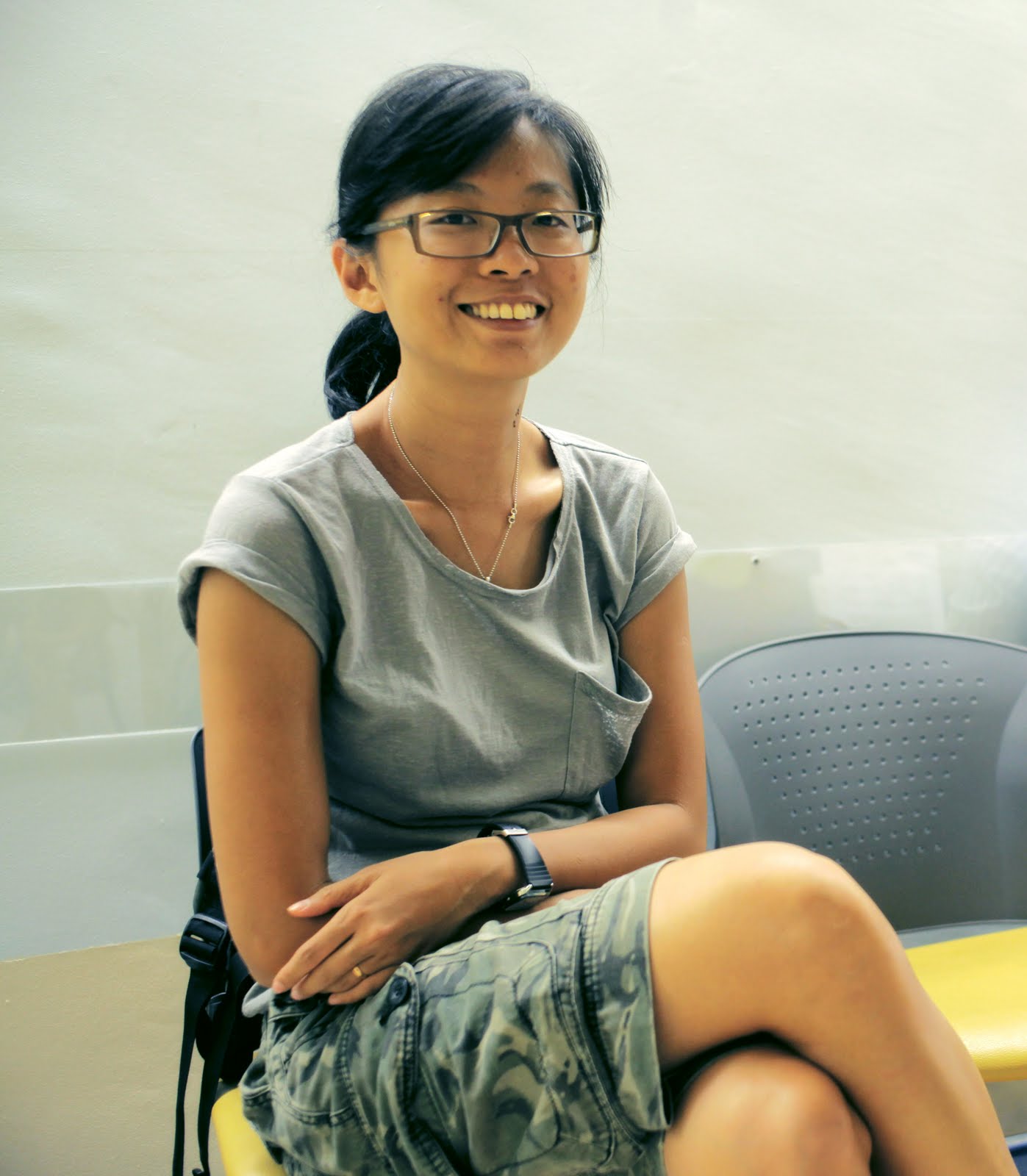

Calm and ready to take on life's surprises


J: If you are given S$10 million to spend on making a film, what would your film be like?

S: Can I cash that? I will use it for my future children's education! ok seriously, a science fiction, with floating spacecrafts and beautiful jungle scenes, and it'll be about life and death and everything in between and beyond. But then all this will remain fiction, till someone actually shows me the money.

J: Would you starve for the sake of art?

S: I'm non-violent, so no. Anyway the money that can buy you a meal can't pay for anything to make a film. So it'll be silly. If by starving you mean to give up the kind of lifestyle depicted in fashionable magazines... It never appealed to me anyway, so it means I won't miss anything. Those kinds of lifestyles in my opinion is a kind of prison, so it's better to steer clear of that.


On the high voltage set of 'Dirty Bitch'

J: A lot of new batches of filmmakers are coming out of school. Could there be too many filmmakers in the scene? And sometimes, many people also make pieces that they call films that are actually not films, more like videos or little expressions on video and it seems to crowd the scene. Do you think it will get overcrowded soon?
S: I think it's ok. I think those are valid forms of expression are well. Some of these people may or may not end up becoming filmmakers for life but I think it's perfectly ok for the layman to pick up a camera and shoot. I mean you are also using your phone to record this conversation and back then journalists only record conversations with those tape recorders.
J: Actually they still use those.
S: Oh yes, they still use that (pause) but you see it's just another form of expression, some do it professionally, some don't. Look, everybody writes blogs these days but how many people make a career out of it? I actually think it's good. Well, let's put the wannabes aside. There are people who genuinely want to document phases of their lives and aspects of society that we don't do. Even those people who document people going mad on the MRT (like the case of the woman spewing vulgarities); it's part of documentation. (pause) But perhaps on the issue of bread and butter, it does have an effect somewhat. I mean not just film, many things are overcrowded, just like the F & B business. And you can't say someone who opens a stall is not F & B. It is F & B.


Sun lending a different eye to the shot

J: But do you think there is enough space for the new graduates?
S: Probably not. Actually, I already see it happening. Many of them slide off into perhaps broadcast design, which is also part of the industry. I know many of them start off wanting to become directors.
J: I guess it also depends on what they are looking for right?
S: Yes. If you are a more auteur-like sort of person and love to tell stories, it will never be overcrowded. All the more you have to stand out with your vision. And competition is good and very healthy.
J: People say it's also the same everywhere else in the world - bigger ponds but more fishes.
S: Ya. It's true. (pause) Maybe 20 years ago, if you were a film director, there is this cloud of mysticism around you. They think you are special or something. Actually, we do rely a lot on the help from our collaborators to make the work.
J: I know what you are saying. When you tell people you are a filmmakers, they go wow ...
S: And then wait till they see what I really do for a living on a day to day basis!
We both laugh.


Riding the 'Dirty Bitch'

S: So there is no big deal. But I think the big deal might be if you could create work that resonates with people - that would be the big deal. (pause) And it would be the same big deal if you were a songwriter or if you created the iphone that records this interview. (pause) You know the richest man in Malaysia manufactures toilet paper?
J: Really?
S: He's the big deal! (pause) You will find your niche if you are really good at something. I mean maybe there are like 3 million other suppliers of toilet paper and they are probably not doing quite as well as him.
J: So other words, there is still hope.
S: You will always find your niche.


We proceeded to snap a few photos borrowing the very 'colourful' background but out came a tigeress of a KTV lounge owner who asked where we were from and wanted to chase us out for snapping pictures. Sun (below) was in middle of posing for my camera when the lady pounced on us and Sun, quick on her feet, fended off the lady's pressing questions in the picture.


Sun broke into the scene when her first short film won a Silver Hugo in 2002 at the Chicago International Film Festival, making her still the only Singaporean with that honour. Oscar-winning director Martin Scorsese received the very same award for his debut short film. She then went on to direct TV documentaries, dramas and commercials. Her latest film "Dirty Bitch", she won Best Director as well as Best Film at the first Singapore Short Film Awards at the beginning on 2010.

Her first foray into feature films was with the Lucky Seven Project, which brought together 7 directors to direct an omnibus film. She is currently developing on a new feature film titled A Million Monkeys. Here is a link that gives a riveting description of the film's working synopsis.


'I wonder what's in store in the Year of the Rabbit?'

Monday, November 22, 2010

LUNCHBOX 6 - Anthony Chen

We simply went the distance for this LUNCHBOX. No prizes for guessing where we went to catch our subject.

Sunday 21 Nov, 10 pm

Changi Airport Terminal 3


Jeremy (J): So apart from the film I helped out in, what other things are you doing right now?

Anthony (A): Currently working on my first feature film. Hopefully we will go into the production in the middle of next year.


J: Are you in the scripting stage?


A: Yes, in the scripting stage and trying to complete financing on that film. Then, hopefully we could start pre-production in January.


J: Is this going to be done in London or Singapore?


A: Singapore. (pause) It’s very important that I make my first film in Singapore.


J: So how are you straddling between the two countries? I assume you are based in London?


A: I would say based between Singapore and London.


J: What do you do when you are back there?


A: Load of development meetings. I am developing a few different projects there. Meetings with production companies and producers…. Developing other features…but this is a long process and you’ve probably have heard of the term development hell. (pause) Hopefully I will be doing some commercials in London but it’s quite tough because I am not physically there all the time. So it’s hard to do the shorter projects there.


J: So what can the audience from your feature film?


A: It’s exploring the same themes that I have always been doing – family drama. Very much in the same genre as Ah Ma, Haze and even the latest short I made in the UK. It’s about growing up, coming-of-age, family. Subconsciously, it has become something that is recurring in my films. At the same time, I think it is also because of some of the directors that I really like… directors like Edward Yang, Hou Hsien Hsien, Kore-eda whom I love a lot. Erm… Ang Lee too.


J: Has the London experience had any influence on your films?


A: The reason why I desperately want to make the feature in Singapore is because it addresses what I am about and where I am from. At the same, I think there would be quite a few collaborations with Europe in terms of the crew and even post-production. I think is going to be some form of collaboration, be it in sound or cinematography. I think that probably is the nearest link to London. (pause) With Hotel 66, I really, which was shot in London, I really wanted to explore the stylistic part of myself, that’s why it was a little heavy on production design. (pause) For the film that I am doing in Singapore, hopefully it is simple and humble. Not trying to be anything. You might not have seen it but I actually made another short film after Hotel 66, which was very back to basic, very personal, very observational kind of storytelling.


J: This is probably something a lot of the younger filmmakers will be interested to know. After having the Cannes and Berlin exposure (and you know not everyone can get that) and with the media playing it up in tiny little Singapore, did things get a lot of easier for you? In terms of your career? And how about being an Asian in Europe pursuing your vision?


A: Probably not easier in Singapore, unless you really up-play certain things and you are hungry to do just anything and everything. But I am quite picky and selective about what I do… and I don’t think I have been doing ‘proper’ work for the past 6 years. I have always been doing pro-bono, non-profit work. I have never really made money. (pause) Interestingly, I observed things to be a little different in Europe. People, I mean, producers make the effort to understand the filmmaker before making any decisions. Also, they seem to value the film festival credentials of the film more in Europe than in Singapore. Things are a little more pragmatic here.


J: I guess I am coming from the point of view of a person who wants to know the ‘route’ or to put it a bit awkwardly, the ‘route to success’?


A: Mm…. I may not be the best person to answer this! (laughs) However, and I can only say it in my case, I have had an easier time in Europe than in Singapore. (pause) Just digressing a little, the ways things work over there is quite different. You walk into a meeting with producers and you realized that they have done their due diligence on you. And I am also able to get feedback from these producers through my agent. In a way, the environment is very nurturing and it does not only apply to filmmakers but writers and people in other creative capacities as well.


J: Actually what you said is not very new. We all know too well how things work here. There are ‘KPI’s to be met – you know what’s a KPI?


A: Yes. I know that very well (laughs).


J: Sadly, this is true not only in film, but also in many other professions that also involve creativity. Perhaps society needs to change before you even talk about a sector like film. (pause) Actually I would like to link this to my next question. Erm, it is something you brought up when we met at the National Museum last month. You mentioned that you observed that many Singaporean filmmakers are churning out a lot of films, causing a dilution of the quality of films here or what a film may be truly defined as. But you know, some people will tell you that this is the age in which anyone with mobile phone can also make a film, who are you to tell…


A: Yeah, I mean it’s true and it’s about this whole purist dilemma. But I don’t think it is about the budget. In fact, one of the first films I am going to make after my feature is going to be really low-budget, like no-lighting, small crew, non-actors. I believe the story can be told that way but I feel it is very important that there is a certain form of discipline in the filmmaking. I am not into the whole ‘to be a filmmaker, you need to go to film school’ saying because there brilliant filmmakers who did not have formal education. Perhaps because in the past, it was so difficult to make films, so there was a lot of thinking before launching into something. (pause)


So I just think people need to think further than just to go ‘You know I am free this weekend, let’s make a film’ or ‘I am going to shoot a feature in one day. You know it’s realty interesting,. I just came back from Taiwan and had a very interesting discussion with a filmmaker friend of mine there. He said you can’t dictate what film is because film means something different to everyone. I tend to agree because some people see film as art, some people see film as a tool to make money. Some people see film as a political device. Some people see film as something that can be put on YouTube.


I think we, in Singapore, are in a very awkward position because we are not in a homogeneous society. We’re not Korea, China, Taiwan. We do not have a product that just caters to our local population. So it makes it very important that the product can travel overseas. So in a way, you need some form of branding. Among my Taiwanese and Hong Kong friends, it is slightly easier because of their history or heritage of films. But for us, it is more difficult. We have to fight so hard to convince people.

I just came back from a film financing forum and learnt a few things. I looked at the box office numbers of Singaporean films for the past twenty year. 8 to 9 out of 10 films lost a lot of money and you are looking at films with stars in it. The only films that constantly make money is films by Jack Neo. We don’t even need to look at the figures to know they make money. In fact, every single film, clocks a minimum of one million. One the other hand, there are films that make only 3000 in Singapore when it cost half a million to make. So in a way, we need to sell our product. Unless we can recover that costs, there is no way to get investors interested. Or they will say they will give you 10,000 to make it. But with 10,000, you can’t do very much that is fit enough to be picked up by the distributors. So, we don’t want to be trapped in this vicious cycle.


One top of this, film branding is not just influenced by the people working in that particular film itself. It can also be influenced by the general perception of films from that country by the rest of the world. You can be an award-winning filmmaker or an amateur filmmaker, all of us make up the general picture that is being judged by others. As a matter of fact, Singapore does indeed send 300 – 400 short films out to film competition overseas every year but the general tide of opinion towards them have not always been positive. Sometimes that can become a vicious cycle because our credibility is affected.


It also does not help that the films that are doing well in the film festival circuit are really arthouse, making it difficult for investors to be convinced about financing our films. So the moral of the story seems to be that we either make really bad films or we make arthouse films that are good but hard to sell.


J: Do you think the loophole in this is the ‘excessive submission’, so in fact we should continue to encourage filmmaking but to let the filmmakers know the difference between a film fit for a competition and a film good enough as a classroom project or for self-amusement.

A: I think it is interesting but I won’t name the person. I know the previous head of film school in Singapore who actually stopped his students from submitting certain films to festivals because he felt they were not good enough to go out. So I feel in a way, we need to contain…..


J: Opportunistic behaviour?


A: No not really… what I mean is everyone has a part to play to uphold a certain standard of filmmaking quality. And I am not talking about the medium. It could be really low quality, shot on DV, but what I saying is the quality of the story. I am sure there will be people who will argue against that because it is very hard to decide what is a good or bad film. It is subjective. But generally, everyone needs to come together to uphold the standards so that we are not known as people who are churning out quantity. In some years, we can get as many as 30 feature films, I think that year was the year when Lucky 7 and 881 were out. It is really huge for a country like Singapore.

(pause) You know, I am also noticing that people are thinking that it is very easy to be a filmmaker, in Singapore especially. Particularly in Singapore, everyone only wants to be the director, they forget that there are many other interesting roles to fill as well. Also, the media seems to be propagating that it is easy to be a Royston Tan or Boo Junfeng and that suddenly, so many local films are making it to Cannes, Berlin and Venice. But what many people may fail to see is that filmmakers could be working 20 hours a day, not earning much, no bread, no butter. It’s really tough. I think peple need to understand that there is something called ‘madness’ when it comes to filmmaking and you really need to …


J: Be a little mad.


A: And you really need to be risking a lot. It’s not really that glitzy. There is no ‘Light Camera Action’ red carpet whatever. It is so easy to think that that’s filmmaking but it really is not. I have been making films for a couple years and the day before my shoot, I am still sourcing for last-minute props, trying to solve production problems and all that. It’s not comfy at all. It’s really tough. People need to realize that it is not easy. It’s a tough route.


Some people are stirred up by the illusion that it is cool to be part of the film industry and the great number of film schools around here seems to support this buzz. But they don’t know that the money isn’t there. Jobs are tough. There is a lot of crap you have to go through. That is not being told. I am fine with the media encouraging people to go into filmmaking but people need to know the pitfalls. People need to be mentally prepared for that.


J: I guess what then happens subsequently is the drop out. True enough people want to get into it but at the same time, there is high drop out. So by the ecological balancing forces of it, people get eliminated and then realize that they might have a better future in TV or advertising. So in fact, people do see the reality after a while.

A: I don’t doubt that but I am just wondering if it is worth their time to go through 4 year of film school and only realize this is not for them after that. I mean even I am starting to feel that it is really tough./ You know in Taiwan they have this saying that you must be either dumb or crazy if you want to be a filmmaker (如果要拍片, 你不是傻子就是疯子。)

J: You kinda answered the last question I have for you – ‘Would you starve for the sake of art?’

A: (laughs) I have been starving so much you have no idea what I have been through. There are times when I so enjoy going to production so much, even my own because there is always catered food or 杂菜饭 (mixed rice) or whatever. Or if the shoot starts too early, you get to claim the taxi. So on $20 you can use it to take taxi again and there if free food……. You just feel so blessed to be on the production!


'Calling all passengers on flight SQ.................' and off he runs into the departure gates. I shouted across to say I wanted to see the finished product of his recent shoot.


Check the time on the clock!

Thursday, May 20, 2010

LUNCHBOX 5 - Martyn See

Saturday 15 May 2010, 6pm
Furama Hotel, Room 2309

6pm:
I raced all the way from Hong Lim Park to room 2309 of Furama Hotel to pass the editors the first completed tape from my video team. We were capturing live interviews at the Pink Dot event. Martyn's just got in to kick off the final leg of the Pink Dot video team's assembly line - the edit. There is no pay in this and he knows the job will probably end around 3 am. But for him, volunteering for a good social cause is as natural as how he does his job of editing.


For those who don’t know Martyn See, he is a Singaporean who survived 15 months of police investigation for the making of banned short film ‘Singapore Rebel’, deemed to be an illegal political film under the law. He has since followed up with ‘Zahari’s 17 Years’, a documentary on an ex-political detainee, and ‘Speakers Cornered’, a chronology of brief scenes from a street corner standoff between pro-democracy activists and the police. Otherwise, he is mostly a law-abiding Singaporean video editor. Feature editing credits include Mee Pok Man (1994, Eric Khoo) That One No Enough (2000, Jack Neo) I Do I Do (2005, Wen Hui, Jack Neo) Singapore Gaga (2005,Tan Pin Pin) Just Follow Law (2007, Jack Neo), Money No Enough 2 (2008, Jack Neo).


It seems to all fit into a nice complete picture now. Just slightly more than a month ago, I asked him out for an interview for our regular LUNCHBOX series. We spoke at lengths. There were plenty of rich anecdotes but nothing beats seeing him in action. So working with Martyn on the Pink Video is seeing those spoken views and fervent beliefs come to life. Here is what we spoke about in April:

Jeremy:
I notice from the time you started yr blog till your latest post, it seems to have come full circle, in terms of dealing with the issue of being able to conduct political discourse in a public space.

Martyn: I started this blog in late 2004 primarily as a platform to promote ‘Singapore Rebel’ as a short film, that’s why it was called singaporerebel.blogspot.com.

J: I thought the blog was a reaction to being questioned by the police after you made the film.

M: No, I started the blog about the same that I made and the same time I submitted it to SIFF. And, yeah…. I wanted it to promote political films.

J: Were you the first person in Singapore to make political films?

M: No, I am not the first. The first people who made political films and were harassed by the police for it were Kai Sing, Mirabelle Ang and Christina Mok. They were all lecturers in Ngee Ann Polytechnic FSB in 2000. They made a film about J B Jeyeratnam and allegedly the police came and they confiscated equipment and they warned them not to do this. The news was buried for a year and at the end of 2001, their contracts were not renewed. Straits Times’ Tan Tarn How found out about it. So, basically he wrote about the incident. Until today, the 3 filmmakers have not spoken up about it. 9 years later, they are still traumatized. (pause) So ‘Singapore Rebel’ for me was an attempt to make everything transparent.

J: Did you make it after the incident or did you make it at the same time as the incident?

M: No, no. no. After the incident. In late 2001 after the general elections, I approached Chee Soon Juan and started gathering my materials to make the film. The blog was basically used to announce where and when ‘Singapore Rebel’ would be screened.


6.10pm:
Jeremy: You ok with this camera? It was a bit faulty the last time I used it.
Martyn: Yeah, don't worry.
Jeremy: When do you estimate you guys will finish the edit?
Martyn: Don't know. Depends on the number of tapes.

Jeremy: I estimate about 6-7 tapes.

Martyn: .....


J: I guess the blog has gone a much longer journey since, covering other grounds.

M: Yeah, because it was banned and ran into censorship problems, so it became a blog about censorship. And since censorship is related to political decisions, so it became a political blog. Yeah, I sort of moved in that direction incidentally.

J: I meant the word ‘circular’ about your blog because the most recent post was on the anniversary celebration of the SDP and the press’ interview of Chee Soon Juan. It seems the press has softened their approach on him and they have achieved what you wanted to achieve…. And you mentioned you want to move on to find new grounds….

M: Ya. You are right. I avoided talking about Chee Soon Juan for 4 years and suddenly The Lianhe Zaobao (联合早报) decided to feature him in an article for the 30th anniversary of the SDP. I thought hey, this is exactly what I was trying to do with ‘Singapore Rebel’, basically to document this guy. Now it seems the mainstream press has softened their words. The good thing that came out of this is …. Well (laughs) perhaps I have been proven to be ahead of my time la!

J: Was it only Zaobao?

M: Straits Times ran a story on the anniversary as well but Zaobao did the in-depth interview.

J: Correct me if I am wrong. Is Zaobao more liberal?

M: I wouldn’t know.

J: I am saying this because I find that the Chinese media tends to be more democratic. One good example are some Chinese radio stations like FM100.3. They really speak their mind about sensitive issues and I don’t find this in any of the English stations.

M: However, you must also realize that the Wanbao (晚报)is very tabloidish and it carries a lot of weight in terms of influencing the heartlanders’ opinion. So the government knows that you can sway opinions with the Chinese press and therefore, they are still keeping a tight reign on it. So they may seem to be freer but come election time, They may not be. They may become as anal as the English press.


J: I initially wanted to do this interview chronologically… sort of starting from how you became interested in doing political films. But I saw several interesting developments on your side recently that were seem more interesting to address. I saw this video


,
linked in a letter (http://www.rsf.org/Open-letter-to-Prime-Minister-Lee,36832.html) by Jean Francois Julliard to PM Lee Hsien Loong about the recent New York Times case. It is from the website ‘Reporters Without Borders – for Press Freedom’. In it, you were responding to the censorship board’s decision to ban your films. Given that this letter is addressed to the PM, are you afraid to be openly named in it?

M: Well, I am basically just stating the facts that the Films Act was not a liberalization. It was basically one step forward but 2 steps backwards. I just spoke matter-of-factly. So I don’t think it would be defamatory at all. So I am not too worried. I was actually quite happy I was able to help their letter a local angle. Otherwise, they might be totally accused of coming from a Western point of view, or trying to impose Western values on us.

J: Where were you speaking?

M: I was actually at a forum in South Korea and Jean-Francois was there. He pulled me out for a 5 minute interview there.

J: Do you think anything will come out of the letter?

M: Well, surprisingly, they have yet to respond. Normally, they will respond, through their private secretary. Perhaps the letter took them back.

J: I sometimes wonder where letters to the PM or President go? Do you need special channels to reach them? It feels a bit like a black hole to me cos you don’t know if your letter will make its way up to be heard.

M: Well, they do read it.

J: I read on your blog that some of the people in authority know your name.

M: I am sure they do and I don’t mind.

J: Have you met them in person before?

M: As far as I know, the only people who have met me are the police officers investigating my case. I have not spoken to any MDA officers. I have only spoken to the people at their front-desk for the purpose of submitting my films. And whenever they approve or ban my films, I get a letter from them. I have had no direct communication with MDA in the last 5 years.

J: I read a particular blog post in which MM Lee mentioned your name?

M: No, he didn’t mention my name. He basically told TIME magazine at the end of 2005 that if it was up to him, he would have allowed ‘Singapore Rebel’.

J: So he’s heard of your film.

M: Well, the question was posed to him by TIME magazine. So I can’t say at the time of the interview he had already heard of the film or not. So, perhaps that might have been the first time he heard of it. The irony is even though he said he would have allowed, the police investigation on my film was only resolved much later and the ban was lift a year later.


7.45 pm
The door creeks open and Martyn is combing through some rushes for good sound and visual bites. I arrive with the rest of the tapes meant to be digitised. Martyn turns around, slightly stunned by the number of tapes I had in the ziplog bag - 8 in total. We checked the clock, it was 8.15 by then. Having seen worse editing days, he took all 8 and laid them out like a professional. Feeling guilty, I promised him I will be back soon after I freshen up at home.


J: I am curious to know about your experience of the 15 months of investigation. Were you detained at all?

M: No. Basically, I went to the police station 4 times to give statements to answer questions. At the second interview, I had to surrender my camera and tapes.

J: So that was after you submitted to SIFF?

M: Yes, I submitted to SIFF, SIFF submitted to Board of Film Censors, Board of Film Censors warned SIFF to warn me to withdraw the film. And after I withdrew the film, I sent the film overseas. Two months later, MDA filed a police report saying that my film has violated section 33 of the Films Act. So that’s how the police investigations started.


J:
During the 15 months, were you deterred from making other films?


M:
During the 15 months, I was researching Said Zahari’s story and I made ‘Zahari’s 17 Years’ within that 15 months. And I submitted again to SIFF and SIFF for some reason again didn’t want to show it. It was about a year later that I decided to submit the film myself to the board of Film Censors and it was there that they told me they decided to ban it then.

J: Has anyone overseas contacted you about the films you made? I mean most of your films are on YouTube and being watched by many people.

M: No not much. Other than people, I don’t get that many comments.

J: I mean, I am sure they could be writers who might use your video for referencing purposes?

M: Once in a while…I get an email from some academic saying he wants to show this to his students either here or in Australia. Or some student wanting to interview me for his thesis. In fact, the first overseas contacts I had after making ‘Singapore Rebel’ were International Body for Human Rights, Amnesty International and Reporters Without Borders. This was because there was a possible threat of a 2 years imprisonment and up to $100,000 fine. So I became a mini celebrity in the eyes of the international human rights organizations. In terms of local people emailing me to know more about me, I got very few. I would say my blog is not very widely read as well.

J: Your blog? (unconvinced)

M: Because most people do not go on the net to read political stuff. Hits are very low.

J: Sadly, this is something very real. When I look at the blogs that garner the most visits, I realize people like to know more about what people are eating, wearing, doing, the latest colour of their hair and frivolous stuff like that.

M: I mean, look at Xia Xue and Mr Brown.

J: Before the incident of the 3 lecturers, did you always have the sense of wanting to speak up for the underdog? Where did that come from?

M: I was born with it. I mean I read Francis Seow’s ‘To Catch a Tartar’, which was quite a revelatory book to me. But a lot of people have read it as well but they don’t do the same thing as I do. (pause) A lot of people went through the same education as me. I have been educated only locally all my life. So I think it comes down to the fact that I was born with a conscience. I was born with a sense of…. Not being able to sleep peacefully if I see injustice and I don’t do anything about it.

J: This is really amazing. I mean I spent 3 years overseas studying and whenever I hear news like that overseas, it angers me and embarrases me a lot too. But less so when I am back home. But for you, you’ve always been here.

M: So, I would call myself a ‘freak’ of PAP’s education system. My first school was basically PAP kindergarten.

J: Did your parents influence you in anyway?

M: Not at all. (pause) If I were to trace back to the seed of this sense of discontent, I would say it goes back to my birth! So you can say I was born with it, though ‘To Catch a Tartar’ opened me to a darker side of political history and detention without trial.

J: So when you had these feelings back in those days, did you tell yourself when you grow up, you want to do something about it?

M; Well, it perturbs me everytime I see people being bullied. But, I didn’t tell myself I needed to do something about it. So, I held back. (beat) I think maybe it is due to the social climate here as well…. Not to provoke authorities, not to overstep OB markers. So I was quite a kiasu Singaporean in that sense, but issues still bugged me and cause me sleepless hours at night. (beat) So, as I got older, I became more likely to act upon my concerns. Hence, I made the little short film about Chee Soon Juan. And after it was banned and under police investigation, I took a very different path from the 3 lecturers. I decided to make everything public instead of hush hush. I think in that sense it protected me because it would make them look bad if they prosecuted me.

J: How do the people around you in your life feel about your sense of righteousness?

M: My mum doesn’t know. I would only let her know if they decided to prosecute me but they didn’t. She doesn’t read newspapers and she hardly watches news. I have 2 older brothers – they know and they are quietly sympathetic. They thought it was ridiculous to investigate me for such a minor issue. People in the industry know but I was still performing my job as a freelance editor. It did not affect my income, my ricebowl. I was kinda blessed in a sense. (Pause) Ironically, I still do editing for Mediacorp TV shows.

J: Does it seem like a double life to you?

M: Yeah, I always tell people I wear 2 hats very frankly. But 90% of my time, I am a freelance editor, the remaining 10% of my time, I spend thinking about politics and trying to make films that have a political message.

J: I feel it takes a lot of training to be able to wear 2 hats like this.

M: Actually a lot of people in their lives wear 3 hats, 4 hats. I don’t think it is that much of a skill to juggle such things. For me, it is quite natural. I don’t find it a chore, I don’t find it a task to do it. I quite enjoy it.

2.00 am
Jeremy: How's the edit going?
Martyn: Think maybe 3 plus can finish. (pause) By the way, Jeremy do your job... this translation doesn't seem right.
Jeremy: ...... (contemplating) How about 'This is God's gift to us.'
Martyn: Mmm... (typing it out) Thiiis eees gaawwwd's gift toooo uusss. (beat) Gift. Mmm...
Jeremy: Can you also replace Ivan's face with a more 'average' face when this line is said. Something's a bit wrong with that combination.
Martyn: I see your point.
Jeremy: One last comment. I find inserting the balloon view of the pink dot in between the time lapse bits very disorientating.
Martyn: Oh, that's the 'mind-fuck' bit.
Jeremy: Mind-fuck?
Martyn: Yeah. Hard to explain what is 'Mind-fuck' exactly.

J: So what are you like outside making political films?

M; I am probably one of two editors in Singapore who has worked with Jack Neo 4 times. This is stuff I do to pay my bills. I have edited with Eric Khoo, Jack Neo. I do a lot of stuff for government corporate videos. So I am very normal video editor.

J: Are you married?

M: No, I am not.

J: Would it have been more difficult if you were married?

M: It would be more difficult as a freelance person if you are married because the income is not stable and the cheques come in late. (beat) But as far as doing political stuff is concerned, it is an open-ended question. It is a good question. Err…. I don’t think many Singaporean women would want to be with a guy who provokes the authority out of the blue, makes it a point to provoke the authority and does not benefit him financially.

J: I was watching ‘Singapore Rebel’ and I saw the scenes with the kids… I mean for me, I still find it hard how he can bring his kids or wife along…

M: My respect for him comes from him being not afraid to let his family know of what he believes in. He gets his kids involved in what he does. A couple of his kids have gone to distribute political flyers with him. So he keeps them involved. (Beat) None of the PAP politicians I know currently involve their kids. So for him, he is unique.

J: Perhaps, If I were in an incumbent position, the drive to is less?

M: Well, if you are in a position to better people’s lives, you should get your kids involved. If you are in politics to better yourself, to lead a comfortable life, then it does not benefit them to get their kids involved.

J: If you were charged a result of making ‘Singapore Rebel’, do you think you would have entered politics?

M: No, I would not ever enter politics. I don’t like politicians. I don’t trust them. And my job as a filmmaker, as a citizen, as a blogger is basically to check on what is being said by politicians. Even if it is the opposition.

J:
More on filmmaking now, do you have any plans to make films out of the political thread you’ve always been following?

M: Currently, I am too busy editing, mainly TV work, not much film. Honestly, the way I see it, we do not have a film industry yet. I define a film industry as something that can sustain a large pool of professionals who do nothing but make films. We don’t have that. We have a TV industry. The only 2 persons I know who can survive just by making feature films is Jack Neo and Kelvin Tong. The rest of the people – cameraman, gaffers, grips, editors, most of us do TV work or TV commercials. Once in a while, we do a film. But the budget for film… if you ask any freelancers out there… it is usually lower than TV work or TV commercials. (pause) So sad to say, we kid ourselves saying we have a film industry when we actually don’t. (beat) Compare us to a city like Jakarta, KL or Ho Chi Minh. I think they make more films than us.

J: I guess many things are working against us, like small market size.

M: I guess. However, I must say that despite my battles with MDA on film censorship, the Singapore Film Commission does give out a lot of money to support independent films. I don’t this happens in our neighbouring countries. So the money is there though somehow the good scripts are not there. (pause) This, I think is somehow related to the political climate that we live in. People are just afraid to step out of their boundaries, afraid to think out of the box. So we don’t make challenging works.

J: If you were to make a feature film, would it touch on politics as well?

M: It would definitely have politics as a background.

J: I mean you’ve watched a draft of ‘Sandcastle’ by Boo Junfeng. Would you say that it is something you would have liked to make?

M: Well I told Junfeng that I loved the story. Something I would have very much liked to direct.

J: Any other new topics on your mind right now?

M: I always wanted to interview Lee Kuan Yew and Chia Thye Poh (political prisoner).

J: Just a whim or do you have a concrete aim to do that?

M: I do. I hope I can interview him in the basement of his home, where PAP was supposedly born.

J: Finally, something I always ask in my other interviews. Would you starve for the sake of art?

M: That’s a good one man. (pause) No I will not starve because starving hurts the body and I will not do anything to hurt my body just for the sake of art. (beat) But, if I were to make art and if I were to be prosecuted for it, I would go on a hunger strike to protest against the injustice of my prosecution. But I will not starve myself just to make a film, or to finish a painting or to write a book. I don’t think it’s worth it. I think the human body is quite sacred. But when pushed to the limits by injustice, it might then be worth it to use your body to make that statement.

_______________________________

Though 'Singapore Rebel' started off as a blog to promote the film, it's become a treasure trove important socio-political news and views that Martyn's collected since 2004. All his films (vieweable online) are linked here too.

You can view his films directly from these links
Singapore Rebel - It's the story of opposition politician Chee Soon Juan, who has been imprisoned twice for championing democratic change in Singapore.

Nation Builders -A documentation of people left behind in Singapore's economic rise.

Speakers Cornered - A recording of the only public protest held in Singapore during the IMF-World Bank meeting in 2006.

Zahari's 17 years - An interview with Said Zahari, a staunch anti-colonial newspaper editor who was accused of involvement in pro-communist activities and subsequently detained without trial from 1963 to 1979.

3.30 am
Jeremy: Hey, they are wondering whether to leave the party or wait for me to deliver the video.
Martyn: Are they going to suggest changes after they watch?
Jeremy: No la. Don't worry. (pause) So how long more?
Martyn: Saving now already... So effectively, we only took half an hour more than last year, with so many more tapes this year.
Jeremy: That's why we chose you ma.
So here's Martyn's (with Natalie Soh) final cut. Till today, it's got 6690 views on YouTube.