Showing posts with label SIFF 2010. Show all posts

Monday, April 19, 2010

SIFF Production Talk- 'Que Sera Sera' by Ghazi Alqudcy

Our guest interviewer Lee Wong speaks to Ghazi Alqudcy on his short film, Que Sera Sera:


Film synopsis:
When I was just a little boy, I asked my teacher, what will I be? Will I be a doctor? Will I be a lawyer? Here’s what she said to me: Que sera sera, whatever will be, will be /The future’s not ours to see /Que sera sera /What will be, will be...

Director's bio:
Ghazi Alqudcy enjoys telling stories through digital film. His works vary in approach – from fictional narratives, to documentaries, to experimental projects. Thematically, Ghazi has touched on issues of sexuality, spirituality, and death.

Graduated from Republic Polytechnic, School of Technology for the Art under the Goh Chok Tong Youth Promise Award Scholarship, he continues making digital films and practicing his storytelling techniques. He is now a student at the School of Arts Design Media, Nanyang Technological University upon receiving the Singapore Technologies Endowment Fund Scholarship, under Temasek Holdings.

Ghazi continues to be active in Singapore’s local film scene, participating in numerous events such as the Take 5! Guerilla Filmmaking Challenge, Fly By Night Video Challenge and the MDA-Panasonic Digital Film Fiesta. In 2007, he held his first solo screening of three films - Lakshmi, Serah Diri, and Block 46 at The Substation’s Guinness Theatre. He took a break for a year in 2008 to learn curate films with his first film screening festival under Republic Polytechnic's Art’s Festival, ‘Play Now Film Fest’ with support from The Substation Moving Images. After that, he curates Purnama Film Screening 1 & 2, under the Singapore Malay Film Society. He was also selected to be part of the Singapore Young Contemporary Artist ‘2008. In 2009, he serves as a judge in the local Fly-By-Night Video Challenge.

He was not film-trained, but he believes that "anybody can be a filmmaker if he perseveres to." His films have been screened in Thailand, Indonesia, London, Australia and also galleries such as Valentine Willie Fine Arts Gallery. Ghazi continues honing his skills through commission works for Prime Minister’s Office, Mediacorp’s Suria, The Artist Village, Singapore Press Holdings, Ain Society and many other companies and organization. During his free time, he loves to indulge in a slumber party with his friends and that is how he usually gets inspired. Currently his motto is "Buy less T-shirts and do more films".

******

Your statement about the film 'Que Sera Sera' says that it's a biographical piece. Were you an unhappy kid, growing up? Is your short film about empowerment?
I wouldn’t regard Que Sera Sera (QSS) as an unhappy film, neither would it be seen as an unhappy portrayal of me. QSS is more of an action-reaction between the past and present in my life. Being who I am allowed me to filter many things especially the choice of good friends, and this is vital. Friends come and go, but good friends will stay. This film dedicated to all the good friends in my life, those who believed in me.

As a filmmaker, is it difficult to be honest in telling a story about yourself?
Before writing the script, I talk to my good friends a lot. I will ask them questions that will allow me to understand them and myself better. It’s easy to write something about you, but whether that’s what people see is another issue. Along the way, small talks, discussion and getaways became a research to understand myself better and the idea to QSS. Writing comedy was easy then, just took my personal experience of those being laughed at, and then reflect upon it.

How did you go about casting (for someone to play yourself as well as the rest of the characters)?
I alerted friends of mine who are teachers and made it like a game. I asked them to find a student in their school that they think looked like me when I was 10. There was no time for rehearsal as I only met the main character 30mins before shoot. We spent time talking to each other, doing poster, writing on the board. You would see the poster he made in the film, which was used as the prop. The other characters were all my good friends. The film initially required a lot of cast, but I eliminate all of them and construct my scene to allow me to only work with 3 characters.

What are the biggest challenges in making this film?
As usual budget would always be the problem. But I told myself, the only thing I will spend would be for the comfort of my crew and cast. I called my good friends (with no film production background) to help me as crew. MOEW House is just a group of friends of various art backgrounds to do things together. My assistant director (Angela Chong) is an installation artist. My Director of photography (Sazeli Jalal) is a fashion photographer. My technical crews (Yue Han, Haidar and Naresh) are my close friends in school. All I want is a fun shoot, and IT WAS FUN. In the middle of the shoot, we changed it to next top model geared with film gears as prop.

How did you go about getting help, in terms of funding and crew support?
The film cost me 50 dollars, which went to vehicle petrol and drinks. I was blessed with friends who want to help. But it is a funny irony though. I asked all of them to help me to make a film dedicated to them. My DP would come half an hour before shoot and say, “Give me a crash course on how to use this camera in 15 minutes” When we were shooting in the parade square under the hot sun, my assistant director would dig umbrellas from everybody’s bag and shelter the crew from the heat even without being prompt. Once again, I would say I am blessed to be surrounded by friends who helped me a lot.

What kind of other help did you get? Say, from fellow filmmakers or classmates, etc?
QSS is part of a class project. Everybody has to make a short film from the given location (assigned by the professor). Grouped with 3 other classmates, we were to complete 4 short films within 2 weeks. Along the way, we learn from each other, making short films of different style and technique. QSS was too personal to me and I did not share anything with my classmate, lecturers, cast and even crew. I produced the film myself and the cast and crew only got to know about the story 30 minutes before the shoot. Everybody was clueless before that.

There is definitely a sense of spontaneity and fun from some of your earlier short films. Would you ever choose to make your film differently? Do you think your films would be different if you worked with professional crew instead of friends?
I have done commercial work with professional crew and I would have to say results are fantastic. And I would not conclude that I won't work with professional crew at all for my short films. But currently what I enjoy most about filmmaking is the process, and I want it to be fun and not stressful.

Any interesting anecdotes to share about the production?
Halfway through the shoot, the parents of my main character (Syahidi) came to set. And that was noon and we were doing the scene of him running around the parade square. My assistant director alerted me about Syahidi’s parents and asked me to finish the scene quickly. It doesn’t look good asking Syahidi to run around. I wouldn’t want the parents to be angry too. Syahidi’s father came to us and said, “Can you please ask him to run some more. It’s the only way to make him exercise.” We were stunned.

What are your views on the film industry here in Singapore?
The film community is growing. Anybody can make a film. We need more films. It's the best time to make a film, just pick a camera and do it!

Do you think local short films are too serious, too depressing?
I won't say all local short films are depressing, because I think there are some cute happy ones. Its quite refreshing to see a happy short film after watching depressing short films. Some of my works are depressing too !!! haha

What's next? Give us some insight to your upcoming works...
I will be spending the next half of the year doing a student exchange overseas. I'm going to Pusan National University and right in time to watch the Pusan International Film Fest. :) If i can't see my film in PIFF, to go there and see others also can lah.. might as well :) hahaha - pathetic me right???? Haha. I want to take this opportunity to do something, get inspired by other cultures, spaces and people. Most of the crew of QSS had an art show last January at Post-Museum Singapore. The same show ‘QUITE’ will be travelling to ANNEX Gallery, Kuala Lumpur Malaysia. I have a sound work installation, an interesting recorded phone conversation.

I notice in your credits there is music by Moby. Could you share with us any tip(s) about the use of music in your short film?
There are many musicians and artist (locally and internationally) who are willing to help budding filmmakers. It’s always worth it to at least try. I remember waiting for Dick Lee to appear from a play just to ask his permission to use his music. I had to wait everyday through out the entire week. We never met him but yes we got his music for the short film, 'We the real people of Singapore'. We managed to get through to Dick Lee through his private email and he gave us the permission to use the song that we've wanted. Again, there’s no harm trying.

Can you name top 5 films that you wish you had made?
Opera Jawa (Director: Garin Nugroho)
The Blossoming of Maximo Oliveros (Director: Auraeus Solito)
Taste of Cherry (Director: Abbas Kiarostami)
The Flower In The Pocket (Director: Liew Seng Tat)
Dogville (Director: Lars Von Trier)

******
QUE SERA SERA is in competition at the Singapore International Film Festival 2010. It screened on April 17 and will be re-screened on 24 April, 11.30am at Sinema Old School. Get your tickets!

Tuesday, April 13, 2010

SIFF Production Talk - 'Memories of a Burning Tree' by Sherman Ong


Synopsis

Smith comes to Dar es Salaam to tie up some loose ends. He meets Link, a tourist guide, who agrees to help him. Along the way they are offered help by Abdul, a grave digger, and Toatoa, a metal scavenger, who themselves are searching for answers to their own journeys. Their search eventually leads them to realise that this is a never-ending journey of dreams and disappointments. With an ensemble cast of non-professional actors and an improvised script, this film is an homage to the road movie genre, where ultimately the road ends when you want it to end.

Biography

Sherman is an award-winning filmmaker, photographer and educator. Straddling fiction and documentary, his films were exhibited in Europe, US, Brazil and Asia and have won awards in Hong Kong, Greece, Italy, Indonesia and Malaysia. He is an alumnus of the 1st Berlinale Talent Campus 2003 and has premiered works at Rotterdam Int’l Film Festival, Int'l Documentary Festival Amsterdam, Institute of Contemporary Arts London, International Electronic Art Festival VideoBrasil and the Fukuoka Asian Art Museum.

He was a jury at the La Cittadella del Corto Int’l Short Film Festival, Italy 2004, Substation Reel Revolution 2006, mentor for the Panasonic Digital Filmmaking Competition 2006 and jury for Singapore International Short Film Festival 2008. He is an Associate Artist of the Substation and has conducted workshops in Singapore at Objectifs – Centre for Filmmaking and Photography, Republic Polytechnic, Nanyang Technological University and the Singapore National/History Museum, and in Cambodia together with Antoine d’Agata (Magnum) for young Asian photographers. 

He has participated in photo-media group exhibition to Singapore, Melbourne, Jakarta, Hanoi, Stuttgart and Berlin under the Goethe Institut ArtConneXions Project (www.goethe.de/artconneXions). He had solo exhibitions in Amsterdam and in the Angkor Photo Festival, Cambodia, and group exhibitions in Noorderlicht Int’l Photo Festival, Netherlands, Aranjuez, Spain. In 2007, he is exhibited works at a Biennale on the Tropics in Brazil, PhotoQuai Musee du Quai Branly Paris, Singapore Art Show, and is artist-in-residence at the Fukuoka Asian Art Museum. 


What is the Forget Africa project about? 
This is the statement by Gertjan Zuilhof, progarmmer of IFFR and initiator of Froget Africa:
He was assisted by 
Inge de Leeuw, IFFR.

Forget Africa, International Film Festival Rotterdam:    

“Forgetting Africa is of course intended slightly provocatively in this case. It is not the intention to give up on Africa, to turn our backs on the lost continent. We do want to take a new look at Africa. See whether it’s possible to develop a fresh view. To see Africa for the first time as it were, also partly in a literal sense. The way economic and humanitarian aid organisations have also asked themselves for about 50 years whether they have helped and have not only evoked a call for help, that’s how questions about African cinema could also be asked afresh.

We shall first ascertain whether they are really there. Then we will become acquainted with them, because we have more than a simple suspicion that they do indeed exist. Then we’ll invite several of them to show their work within our project. A project in which the imagination of Africa is brought back to the earth.

 “They” are the still anonymous film makers from African countries like Uganda, Rwanda, Tanzania, Zambia, Namibia, Angola and Zimbabwe. Countries that have been less visible internationally than other African countries with their cinema. Countries that seem to have fallen off the cinematographic map. Research still has to be carried out into a number of countries.

Films are made in Africa. If you include the commercial melodrama production of Nigeria, for instance, then a lot of films are made and even good films get made, even though there aren’t really very many for such a huge continent. In addition, the few serious films come from a relatively small part of the continent. North and West Africa, and it’s no coincidence these are the former French colonies, are over-represented which means that a large area is under-represented. If you look at the programming of international film festivals, and even of specialised African film festivals, you could conclude that no films at all are made in Eastern or Central Africa. Will have to see whether that is really the case and that is the aim of this project.

The Journey

The driving force within this project is an open curiosity about the position and work of film makers who work in the countries that are not really included on the map of cinematography. That doesn’t mean the work doesn’t exist, but it does largely mean that their work does not play any significant role – probably for a variety of reasons – in the international circuit of festivals were virtually every country in the world plays some kind of role.

The most effective and also the most elementary way to become acquainted with the film makers of unknown cinematographic countries in Africa is to visit them. Research in other areas of the world, for instance in the poorer countries of South-east Asia, has taught that saying for some time on the spot, making use of the network of local film makers and other film professionals, does not take long to offer a survey of what’s going on in such a country in the field of film.

Through this approach, the survey itself will form an interesting part of the project. A next step within the project also emerges from this. The open and curious encounter with local film makers gains extra significance and quality if they can in turn be introduced to film makers from other parts of the world who do have contacts and experiences in the international circuit of festivals and markets for film projects. The encounters and exchanges are fertile for both parties in this way. For the local film makers, it provides an opportunity to acquire concrete knowledge and experience from a colleague. For the visiting film maker, it is an equally concrete acquaintance with an unknown cultural world.


Several international independent film makers with a wealth of experience for their relatively young age have displayed an interesting incorporating on the project. After this text, we summarise their names with a concise description of their lives and work.”

How did you seek help?
I made contact w another Tanzanian, Hamis Mtingwa who also attended the Berlinale Talent Campus. From him, I got to meet his other classmates in University of Dar Es Salaam who are in the fine arts faculty which incl film, theatre, performing, painting, etc. That's how I found Smith, the young man who was looking for a grave. Smith is studying acting/theatre. And Peter Mbwago, who eventually became my assistant dir and co-writers together w Hamis. They all just graduated after we finished shooting. My arrival coincided w their submission of the final year project which was great cos then they have time to work w me on the film. Edgar Chatanda and Malto Tambi are two other classmates who were part of the crew.

I also made contact with the Goethe Institue in Dar es Salaam. Another German filmmaker Uli Schueppel, also on this project, was already in Dar shooting. Link was his guide. And of course, Gertjan meeting me at the airport lessen the disorientation of arriving in a strange city and  made my arrival more pleasant.

And how did you arrive at this story of yours? (Though I suspect the story evolved as you were making the film itself)
I went to Tanzania w another idea of a story but I junk it when I got to Dar es Salaam. 
The story was conceived after I had an audition with amateur theatre actors who live in the same suburb as Link Reuben, my guide in Dar. Link works as tourist guide and a painter. It all started when I asked him to take me to his neighbourhood and meet his neighbours. When I met him, he was living w his uncle who runs a cosmetics shop and does manicure/pedicure for women.

The actors collective is like a loose grouping managed by Big Willie and his younger brother, Raymond. They make stories like afternoon soaps using dv cameras and edit them into VCDs, and sells them thru distributors in the city. 
Link brought me to a cemetary near his home and as we were walking, he told me that some of the crosses on the graves are missing cos they were taken by people who sells them as scrap metal...so that planted the seed of the story. We were just taking a walk in the cemetary and talking about general things. And the Christian and Muslim cemetaries are just next to each other. So I decided to have a character looking for a grave and then everything fell into place at the audition. So it was the 'dead' that actually gave me the story and I was just the medium who channelled the stories onto the screen. 

So after the audition, I sat down w Peter and Hamis to write a structure and script in point form in 2 days. This was the blue print for the film - 50 scenes and each scene abt 2 mins. So we had a script, "a beginning, a middle and an end, but not necessarily in that order".

What were your initial fears regarding the success of the production when you first arrived in Tanzania?
I went there w an open mind and didn't have any expectations. Very much like when I went to Japan and then made Hashi.

I am sure I could make something in Dar. There is always drama in the most mundane of things...eating , drinking, crossing the road, getting stuck in a jam. And of course, a bit of luck and a truly wonderful guide, Link - who made it all happen.

Does Smith represent you, the filmmaker, in some way, since he is also trying to find his way around.

No. I had an audition w Hamis' classmates and decide to cast Smith when I found out through my interview that he lost his mother and sister in succession to malaria about a year before. So i felt he would have the emotional temperament to carry the character through and his search for some closure. But I think we are always searching for something as we move along in life...because we all have desires and dreams.

How did you manage to get people to act in your film for free? I feel this is sometimes the irony of wealth. In Singapore where life is stable and comfortable, it is actually harder to get people to act.
It wasn't for free, that was a factual error. I only met Gertjan the first 4 days in Dar and then he left to go to another African country. When I told him I made a feature, he thought I must have really squeezed the budget. 

Actually all the actors got paid equivalent to half a month's salary (of an general worker/employee in a hotel) for 2-3 days of shooting. It wasn't much but still that they could use to tide them over. In fact, except for Smith, the others are unemployed or day-rate workers, Toa Toa attends primary level schooling at  a private school and helps out as a cameraman for Big Willie. Abdul(gravedigger) writes short stories for books/magazines, which is not very often.

Mariam(gravedigger's love interest), a single mother, cooks some food at home, puts them in a bucket and sells them to construction site workers. Grace was taken out of school by the family, presumably because they can't afford it. Miriam (Toa Toa's girlfriend) and Smith are looking for a job.

In fact, the payment was the first thing I had to discuss before the actors agree to be in the film. In Dar, everything is about money, you need to pay someone (almost like a local head/leader) in charge of an area, or ask politely for permission to shoot. So most of the time, I was an exchange student at the university making a short project about Dar and the people. 

And we even had a wrap party by the beach w food cooked by Link's Aunt, who played his Aunt in the film.
I am happy that the film has helped to make a change in the actors lives as they now have the opportunity to go for auditions for other tv/ video projects. And ome money from the production budget was used to fund Toa Toa's school fees for another year.

I don't think there is a big difference between Dar and Singapore; regardless of economic level, everyone still grapples w the discomforts and crises of daily life because we are never satisfied or contented. 

In some sense, Dar feels very much like South East Asia/Indonesia...the tempo of the city and temperament of the people. 


How long was the shoot? How many people were in your production team, I would imagine everyone is quite stretched on set?
We shot for about 8-10 days, a few hours a day and non-consecutive. The team is about 5-6 people, as Link and Smith also helps w the production side. We work w the limitations. Shooting w a small camera helps, Canon 5D MkII. 

What were some of the greatest challenges you met in production?
Shooting in a Muslim cemetary without a permit in a location outside of Link's neigbourhood/territory. My crew was Afraid that they woud be put in jail and fine cos the police are very strict w unauthoried filming. 

The Tanzanian goverment was really upset about a film called Darwin's Nightmare which was apparently shot without their permission and gave a totally wrong perception about Tanzania. I have not watched this film, so I can't comment further. I was told that after the film was made, everyone in Tanzania wants money whenever you point a camera at them. 

What were some of the contraints you faced in making the film and how different woudl the film be if there were no such constraints, e.g. budget, location permissions, cast etc.
The film came out of a certain set of contraints, if the conditions are different then it would be a different film. 


What are the top 5 movies you wish you'd made? (This is just a fun question, please feel free to not take it TOO seriously or intensely. And note: it's top 5 movies you WISH YOU MADE, not top 5 fave movies)
Maybe names of directors would give an indication...
Tarkovsky, Hou Hsiao-Hsien, Jia Zhang-Ke, Fassbinder, Ozu.

For more on the film, you could visit the website.
Or read what Gertjan Zuilof, the Rotterdam International Film Festival Programmer had to say about the film.
Or if you want to know more about Sherman Ong, click here.

Tuesday, March 16, 2010

Highlights of the Singapore International Film Festival 2010 Press Conference

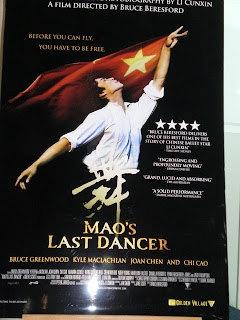
This year's SIFF opening act is 'Mao's Last Dancer'. It tells the story of a dancer from China who flees to the US and eventually becomes the principal dancer of the Houston Ballet.


Geoff Malone, SIFF founder, shares some highlights of the festival. Next to him are Prof Kirpal Singh and Audrey Wong

This year's SIFF screens close to 200 films from over 36 countries between 15th to 24th April. While we open with an epic rags-to-riches story about overcoming the odds , we end with a charming little low-budget called Dear Doctor, in which a medical charlatan with a heart of gold wins over the inhabitants of a Japanese village.


Besides these 2 films,
I am also tempted to catch the following...

Shaking Hands with the Devil by Director Roger Spottiswoode


Liebe Mauer (Beloved Berlin Wall) by Peter Timm


Don't miss the usual selection of local films too!
Here are the details of the festival:

Date:15th-24th April 2010

Venue:Shaw Lido/Sinema Old School/The Arts House/UniSIM/ SMU(Singapore Management University)/Singapore Art Museum

Ticket Price:Opening Film:$20;Closing Film:$20;Other movies:$10
For More Information,Visit www.filmfest.org.sg

And HEY! WE ARE ON THE PUBLICITY BOARD!
Can You Spot Us?